Common in shallow sandy and intermediate habitats of Lake Tanganyika,
occasionally also occurring in deeper water.
Geographic distribution:
Endemic to Lake Tanganyika with a lake-wide distribution.
Several distinct geographical variants are known.
Typical adult size:
Reaches a maximum total length of about 11 cm.
Recommended aquarium size:
Approximately 200 liters for a single breeding pair.
Aquarium setup:
Fine sand substrate is essential, interrupted by scattered smooth rocks
that provide shelter and act as visual barriers between territories.
This species is highly sensitive to stress. Juveniles initially form
schools, but as adults they split into pairs that establish and defend
territories. Excess individuals that are prevented from resting on the
substrate must be removed immediately, as prolonged stress may quickly
prove fatal.
It is recommended to start with a small group, allow a pair to form, and
then remove the remaining individuals. A single pair can be kept in an
aquarium of about 100 cm length; two pairs require at least
130 cm. Never keep together with other active or aggressive
sand-dwelling species.
Diet:
Carnivorous. Feeds mainly on small crustaceans, shrimps and other
invertebrates. Foraging is done by biting into the upper layer of the
sandy substrate. In the wild it often feeds in large schools numbering
several hundred individuals.
Breeding:
Biparental mouthbrooder. Breeding pairs separate from the school once
mature and establish a spawning territory on sandy bottom or within
sandy patches of the intermediate habitat. The female incubates the eggs
and early larvae, but after 7–12 days transfers them to the male, who
continues mouthbrooding until release after about 15–16 days. Brood
size is usually up to 40 fry.
After release, both parents guard the fry for approximately two more
weeks. Studies have shown that males play the dominant role in brood
defence, allowing females to recover faster and increasing the
fecundity of serially monogamous pairs.
Aggression:
Peaceful toward other species, but conspecific aggression can be high,
especially between breeding pairs defending territories.
Special notes:
Unlike most other species of Xenotilapia, this species shows
pronounced parental care toward the fry.
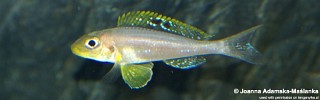



It is recommended to start with a small group, allow a pair to form, and then remove the remaining individuals. A single pair can be kept in an aquarium of about 100 cm length; two pairs require at least 130 cm. Never keep together with other active or aggressive sand-dwelling species.
After release, both parents guard the fry for approximately two more weeks. Studies have shown that males play the dominant role in brood defence, allowing females to recover faster and increasing the fecundity of serially monogamous pairs.
Photo gallery