Near Cape Zongwe, Lake Tangayika, Democratic Republic of Congo
Biotope:
Shallow rocky habitat at depths of about 2 to 9 metres. The species lives in small groups,
which are noticeably less numerous than the large colonies formed by species such as
N. brichardi and N. pulcher.
Geographic distribution:
Southern Congolese west coast of Lake Tanganyika. The typical form is reported from the area
between Longola and Kanoni, with confirmed records around Cape Zongwe.
Typical adult size:
Up to about 7 cm in the wild; in aquaria individuals may reach approximately 8–9 cm.
Sexual dimorphism:
Males and females are very similar in appearance; males are slightly larger.
Recommended aquarium size:
100 L for one male with one or two females.
Aquarium setup:
Provide abundant rockwork to create numerous passages and caves, with fine sand as substrate.
The species can be kept as a pair or with one male and two females.
In larger aquaria it may be maintained in Tanganyika community tanks, where each individual
defends a relatively small territory centred around its own cave.
Diet:
Carnivorous. Feeds on small invertebrates such as insects and cyclops. In aquaria, readily
accepts high-quality commercial foods as well as live and frozen foods.
Breeding:
Breeds throughout the year. Pair bonds are loose, with each partner occupying and defending
its own cave; the male visits the female primarily for spawning.
Brood size is very small compared to colonial “princess” species such as
N. pulcher and N. brichardi, and juveniles therefore do not rapidly overpopulate
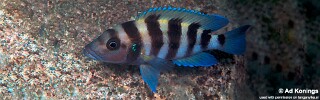
the aquarium. Fry and juveniles display a spotted or striped body pattern that fades with age.
Aggression:
Not highly aggressive toward conspecifics. Toward other species, aggression is mainly expressed
during territorial defence and while guarding offspring.
Special notes:
This species was initially traded as a black form of N. brichardi (“New black brichardi”).
It is often regarded as intermediate between N. savoryi and the more advanced colonial
members of the N. brichardi complex.
With N. savoryi it shares a relatively large head, a low reproductive rate, darker overall
coloration, and vertical body stripes that are most evident in juveniles. These stripes are more
numerous than in N. savoryi, but fewer than in the more advanced colonial species of the
complex.
It is currently unclear whether Neolamprologus splendens represents an intermediate
evolutionary stage toward highly colonial species, or whether it originated through hybridisation,
as has been demonstrated for N. marunguensis.
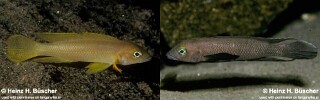
Closely related is Neolamprologus helianthus, described as a separate species by Heinz
Büscher. N. helianthus differs mainly by its lighter yellowish to orange coloration,
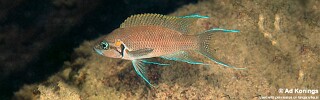
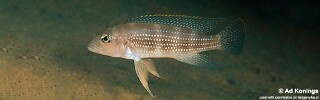
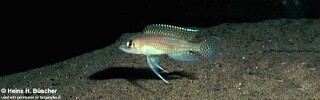
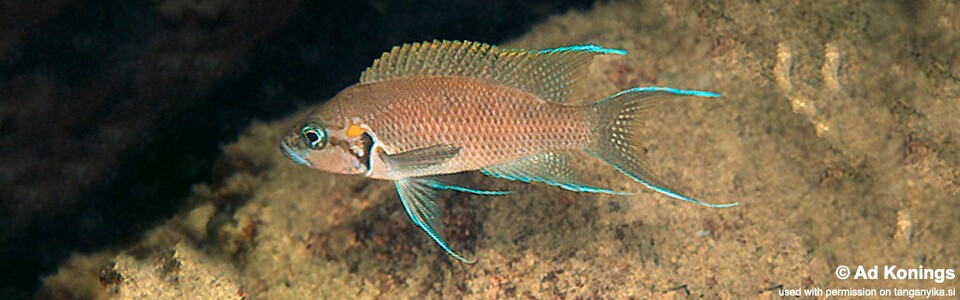
whereas N. splendens is darker, ranging from violet to black. Behaviour and ecology are
otherwise very similar, and both species inhabit adjacent but separate areas. Both can be
distinguished from other 'princess' species, such as N. brichardi, by a characteristic
black V-shaped marking behind the eye.



In larger aquaria it may be maintained in Tanganyika community tanks, where each individual defends a relatively small territory centred around its own cave.
Brood size is very small compared to colonial “princess” species such as N. pulcher and N. brichardi, and juveniles therefore do not rapidly overpopulate the aquarium. Fry and juveniles display a spotted or striped body pattern that fades with age.
With N. savoryi it shares a relatively large head, a low reproductive rate, darker overall coloration, and vertical body stripes that are most evident in juveniles. These stripes are more numerous than in N. savoryi, but fewer than in the more advanced colonial species of the complex.
It is currently unclear whether Neolamprologus splendens represents an intermediate evolutionary stage toward highly colonial species, or whether it originated through hybridisation, as has been demonstrated for N. marunguensis.
Closely related is Neolamprologus helianthus, described as a separate species by Heinz Büscher. N. helianthus differs mainly by its lighter yellowish to orange coloration, whereas N. splendens is darker, ranging from violet to black. Behaviour and ecology are otherwise very similar, and both species inhabit adjacent but separate areas. Both can be distinguished from other 'princess' species, such as N. brichardi, by a characteristic black V-shaped marking behind the eye.
Photo gallery