Near Tembwe (Deux), ca. 40 km south of Moba, Lake Tanganyika, Democratic Republic of Congo
Biotope:
Intermediate sand-rock habitat close to rock patches; occurs at greater depths (15–45 m).
Geographic distribution:
Southern Congolese coast of Lake Tanganyika. Recorded at Tembwe Deux, approximately 20 km further
south at Kizike, and again south of the Lunangwa River. Despite intensive surveys, the species was not found
within the roughly 60 km stretch of coastline between Kizike and the Lunangwa River.
Typical adult size:
Up to about 14 cm; females remain slightly smaller. Juveniles are yellowish; adults often become
increasingly dark and may turn almost black.
Recommended aquarium size:
300 L (for a community tank). A formed pair can be kept in a smaller aquarium, but the species is
often started as a larger group to allow pair formation, after which surplus fish should be removed.
Aquarium setup:
Fine sand substrate with scattered larger rock piles creating deep crevices and caves; lighting should
be subdued. In a sufficiently large aquarium (at least 300 L), it can be kept with other Tanganyikan cichlids.
Due to weak pair bonds, provide ample hiding places; in case of pair break-up the male may quickly kill the
female.
Diet:
Carnivorous; feeds mainly on invertebrates such as crustaceans, insect larvae and snails.
Digestive tract analyses also found remains of plant material.
Breeding:
Spawns inside caves. Pair bond is weak; after spawning with one female, the male may soon spawn with
the next if available. The clutch is usually about 50–100 eggs. Only the female guards the eggs and fry and
often stays inside the cave for a long time until the fry become free-swimming.
Aggression:
High intraspecific aggression; because the pair bond is weak, the male may kill the female after
spawning if the aquarium is too small or lacks sufficient hiding places.
Special notes:
Notable for its very large pectoral fins and elegant body shape; the species name refers to these
pectoral fins. It is considered very similar in habitat and morphology to Neolamprologus leleupi but
is described as less aggressive. It is regarded as especially close to Neolamprologus nigriventris;
both were discovered by Heinz Büscher, show similar size and behavior, and occur in the same broader region,
but were not observed together at the same localities. Büscher recorded this species at Tembwe Deux, about
20 km further south at Kizike, and again south of the Lunangwa River, but did not find it in the roughly
60 km stretch between Kizike and the Lunangwa River, where N. nigriventris occurs. Its movement in
the habitat—staying very close to rocks with the belly oriented toward the substrate—resembles the behavior
of Julidochromis and Neolamprologus furcifer.
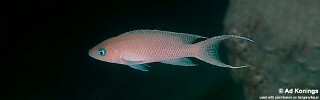
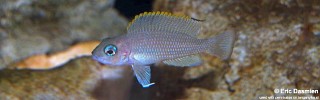
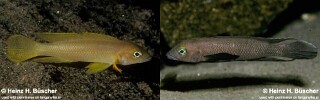
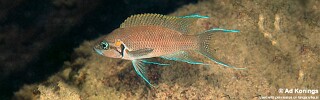
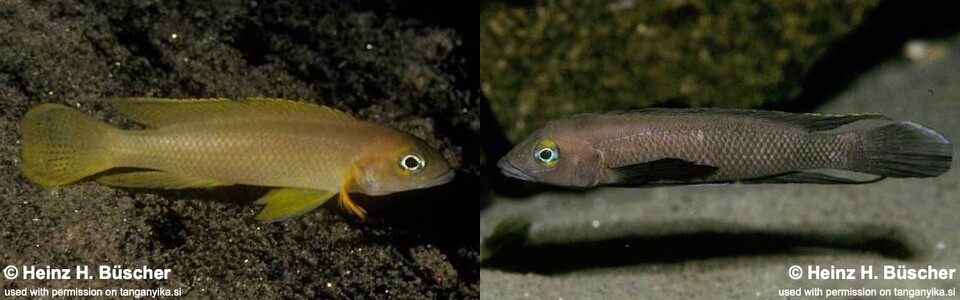



Photo gallery