Intermediate habitat between rocks and sand. The species is most
abundant at depths of around 15 m. It differs ecologically from
Neolamprologus sp. “Cygnus”, which inhabits purely rocky
habitats in the southern part of the lake, while N. falcicula
occurs in the northern part of Lake Tanganyika along the Burundian
coast.
Geographic distribution:
Restricted to the northern part of Lake Tanganyika, along the coast of
Burundi. The species is centered around the Magara area, from which
it was originally described. Since the work of Verburg & Bills
(2007), its range is considered separate from that of
N. walteri and related forms farther south.
Typical adult size:
Up to about 8 cm total length. In aquarium conditions it may grow
slightly larger.
Sexual dimorphism:
Males and females are externally very similar, although males are
slightly larger.
Recommended aquarium size:
Around 100 L for a pair.
Aquarium setup:
Provide plenty of rocks arranged to form numerous passages and caves,
with fine sand as substrate. The species can be kept as a pair or as
one male with two females. Due to its very low reproductive rate, it
does not fill the aquarium with fry as rapidly as colonial members of
the N. brichardi complex.
Diet:
Carnivorous. Feeds on various microorganisms and invertebrates taken
from the substrate or from the water column (plankton). In aquaria,
a variety of live and frozen foods is accepted.
Breeding:
Lives in pairs, similar to N. sp. “Cygnus” and
N. savoryi. A cave is excavated beneath a rock, where
spawning takes place. Clutch sizes are extremely small, typically
only about 1–5 fry. Unlike colonial “princess” species such as
N. brichardi or N. pulcher, this species does not
form groups or colonies.
Aggression:
Can be aggressive toward conspecifics, but is generally tolerant toward
other species.
Special notes:
Belongs to the Neolamprologus savoryi species complex and is
considered intermediate between the solitary N. savoryi and
the colonial members of the N. brichardi subgroup. It lacks
opercular markings and shows a narrow black-and-white edging on the
dorsal and caudal fins, less pronounced than in closely related
N. walteri and N. chitamwebwai.
Historically, several related forms were grouped under
N. falcicula. Following later taxonomic work, the species is
now restricted to the Burundian coast, while N. walteri and
Neolamprologus sp. “falcicula cygnus” occupy Tanzanian and
Zambian regions. Juveniles of the latter show particularly vivid
coloration, which fades with age; adult N. falcicula are
typically grey-beige and rather subdued in color.
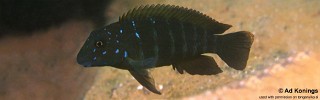
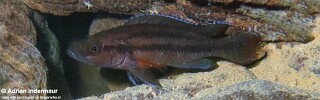
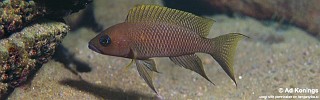
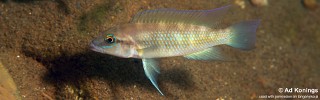
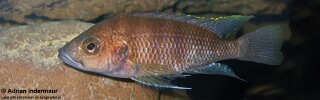



Historically, several related forms were grouped under N. falcicula. Following later taxonomic work, the species is now restricted to the Burundian coast, while N. walteri and Neolamprologus sp. “falcicula cygnus” occupy Tanzanian and Zambian regions. Juveniles of the latter show particularly vivid coloration, which fades with age; adult N. falcicula are typically grey-beige and rather subdued in color.
Photo gallery