About 10 kilometers north of Lunangwa-Fjord, 100 kilometers south of Moba,
Lake Tanganyika, Congo.
Biotope:
Deep rocky and intermediate habitats, strictly associated with rocks and caves,
never occurring above open sandy bottoms.
Geographic distribution:
Originally described from a 100 km long stretch of the southwestern Congolese
coast of Lake Tanganyika, from Zongwe to Livua, and later also reported from the northeastern
Tanzanian coast around Kigoma.
Typical adult size:
Males reach about 10 cm total length; females are usually 1–2 cm smaller.
Sexual dimorphism:
No clear external differences apart from size, with males being larger than
females.
Recommended aquarium size:
Around 200 L for an established pair; at least 300 L if multiple individuals
are initially kept to allow pair formation.
Aquarium setup:
The aquarium should contain numerous rocks arranged to form deep caves and narrow
crevices, with sand on the bottom. Lighting should be subdued to reflect the deep-water habitat.
Only a single pair should be kept, as intraspecific aggression is very high and dominant males
may quickly kill conspecifics. Once a pair is formed, it can be maintained in a moderately sized
aquarium.
Diet:
Carnivorous. Feeds on small crustaceans, insect larvae and other invertebrates
found in deep water. In the aquarium it accepts live and frozen foods such as krill and
Cyclops.
Breeding:
A cave spawner that breeds deep inside dark cavities. Eggs are deposited on the
cave walls. Reproduction rate is very low, with small clutches usually not exceeding about
20 eggs.
Aggression:
Extremely aggressive toward conspecifics. Aggression toward other species is
unknown but is assumed to be lower than within the species when sufficient space is
provided.
Special notes:
A rare deep-water lamprologine characterized by an elongated body, pointed head,
indented caudal fin and very conspicuous longitudinal stripes on the flanks and along the base
of the dorsal fin. Its habitat, scarcity and body proportions recall Neolamprologus ventralis,
while the coloration is reminiscent of N. buescheri. Due to its deep distribution, it is only
very rarely imported and mostly maintained by specialized breeders.
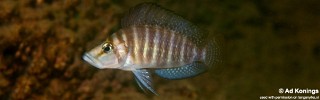
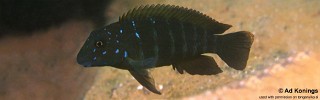
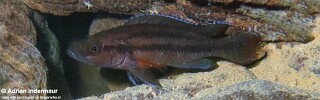
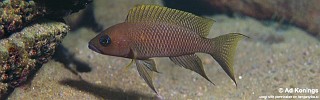
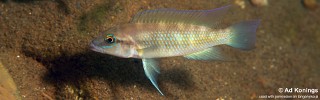
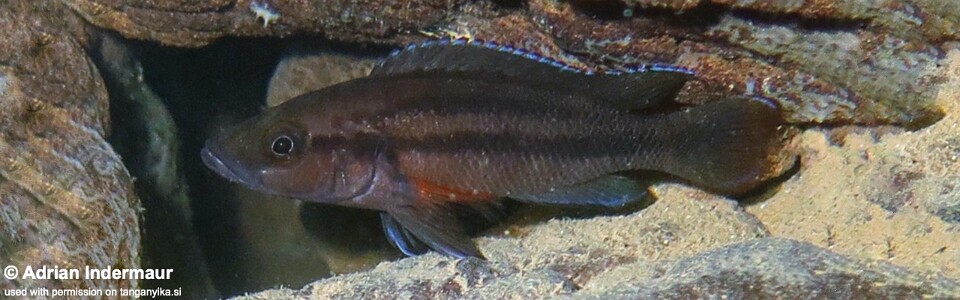



Photo gallery