Shallow intermediate habitat with rocks covered by sand and mud.
Algae are mainly found on stones and pebbles kept relatively free of sediment
by water movement in very shallow zones.
Geographic distribution:
Lake Tanganyika, with a distribution spanning much of the lake.
Reported from areas between Nyanza-Lac (Burundi) and Miyako (Tanzania).
Typical adult size:
Maximum total length of about 20 cm.
Sexual dimorphism:
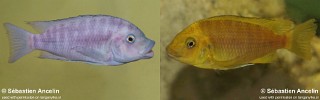
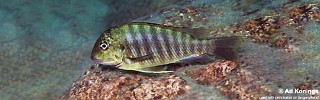
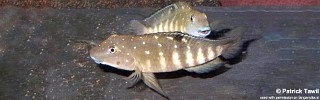
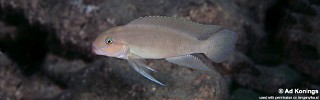
Sexual dimorphism is evident.
Males are territorial and show stronger coloration, including a bright yellow
throat and more intense markings, while females are duller.
Recommended aquarium size:
Large aquaria are required; volumes from about 500 liters and above
are recommended.
Aquarium setup:
Spacious tank with strong structuring using rocks to create visual
barriers and territories.
High stocking densities may help distribute and reduce intraspecific
aggression.
Suitable tank mates are large, robust Tanganyika cichlids with similar
dietary requirements, such as Tropheus and Petrochromis.
Diet:
Herbivorous; feeds mainly on filamentous algae and diatoms
collected from the substrate.
Intestinal length is several times the total body length,
characteristic of a herbivorous diet.
Breeding:
Maternal mouthbrooder.
Spawning takes place within the male’s territory, often in or near caves,
sometimes on sand in front of rocky shelters.
Clutch size ranges approximately from 35 to 90 eggs.
Eggs and fry are brooded for about four weeks.
Aggression:
Territorial and aggressive toward conspecifics and other herbivores.
Males vigorously defend their territories, while females and juveniles are
non-territorial and range more widely.
Special notes:
Despite its wide distribution, the species shows remarkably uniform appearance
across most of the lake, with more intense red, black, green, and yellow
coloration reported mainly from the southernmost populations in Zambia.




Algae are mainly found on stones and pebbles kept relatively free of sediment by water movement in very shallow zones.
Reported from areas between Nyanza-Lac (Burundi) and Miyako (Tanzania).
Males are territorial and show stronger coloration, including a bright yellow throat and more intense markings, while females are duller.
High stocking densities may help distribute and reduce intraspecific aggression.
Suitable tank mates are large, robust Tanganyika cichlids with similar dietary requirements, such as Tropheus and Petrochromis.
Intestinal length is several times the total body length, characteristic of a herbivorous diet.
Spawning takes place within the male’s territory, often in or near caves, sometimes on sand in front of rocky shelters.
Clutch size ranges approximately from 35 to 90 eggs.
Eggs and fry are brooded for about four weeks.
Males vigorously defend their territories, while females and juveniles are non-territorial and range more widely.
Photo gallery