Upper rocky littoral zone of the lake.
Mainly inhabits depths from 1 to 10 meters.
Shows a higher tolerance for sandy patches than other grazing species.
Juveniles prefer very shallow rocky habitats, often with higher plants,
while adults occur in slightly deeper regions.
Geographic distribution:
Southern (Zambian) part of Lake Tanganyika,
extending along the Congolese coast and into Tanzanian waters,
where it is replaced by Petrochromis sp. “orthognathus tricolor”.
Typical adult size:
Up to 12 cm SL and 15 cm TL.
Diet:
Primarily feeds on epiphilic algae (Aufwuchs),
ingesting mainly unicellular algae such as diatoms.
Juveniles also consume considerable amounts of small invertebrates.
Feeding involves pressing the open mouth against the rock surface
and closing it while food is taken up.
Breeding:
Maternal mouth-brooder.
Females incubate around 20 large eggs with a diameter of about 5 mm.
Courtship behavior is similar to closely related species.
Males display in a head-up position and show the ocellated anal fin.
No nest or bower is constructed; courtship usually takes place
on flat rocks within the territory.
Special notes:
The species has been observed to suffer brood parasitism by
Synodontis catfishes, with mouth-brooding females occasionally
hosting young Synodontis multipunctatus.
Interochromis loocki is considered closely related to the
Petrochromis orthognathus species complex, though exact
morphological and geographical distinctions remain uncertain.
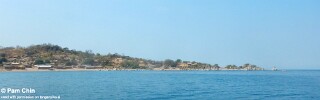
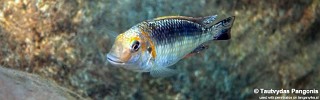
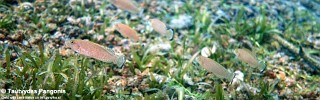
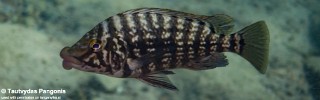



Photo gallery