Benthopelagic deep-water habitats over sand and mud substrates.
During the day it occurs at depths up to about 90 m, while at night it
migrates to much shallower sandy areas.
Geographic distribution:
Lake-wide distribution in Lake Tanganyika and considered the most
common member of the genus.
Typical adult size:
Up to about 10 cm total length.
Sexual dimorphism:
There is no size difference between the sexes.
Males show a species-specific melanin pattern in breeding coloration,
while females are mainly silvery with a small black spot at the beginning
of the dorsal fin and lighter fins.
Diet:
Feeds mainly on easily digestible invertebrates such as diatoms,
insect larvae, mites, ostracods, and eggs.
Most food is taken from the water column at night, sometimes also from
the substrate, using an enlarged sensory system on the head to detect prey
movement.
Breeding:
Maternal mouthbrooder.
Males are territorial and likely form leks, defending small spawning pits
in the substrate.
Spawning usually occurs in the early morning, with up to about 30 relatively
large eggs laid and collected by the female.
Incubation lasts approximately 3–4 weeks, after which the female releases
free-swimming fry and provides no further care.
Aggression:
Generally peaceful.
Aggression is mainly limited to reproductively active males toward each
other during spawning periods.
Special notes:
This species is the most common representative of the genus
Trematocara and is adapted to deep-water life, including diel
vertical migrations and enhanced sensory systems for low-light conditions.




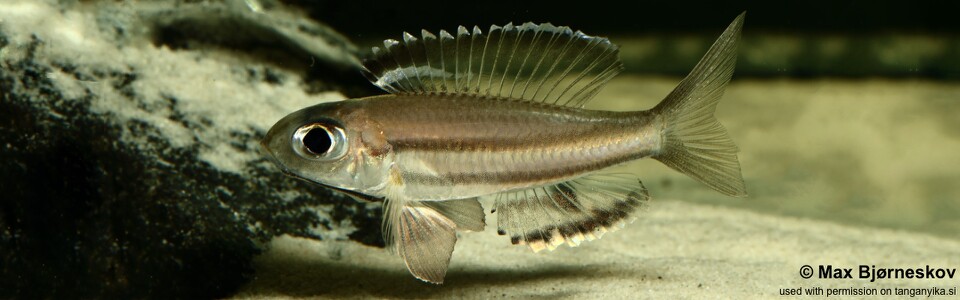




Photo gallery