Most often found in sediment-rich rocky bays of intermediate habitat, typically at depths of
about 5–15 m.
Geographic distribution:
Widespread in Lake Tanganyika, with very little geographic variation reported; variants from
Lweba (D. R. Congo) are described as indistinguishable from those across the lake at Resha (Burundi) and
Kigoma (Tanzania).
Typical adult size:
Males can reach up to about 18 cm total length, while females remain much smaller and rarely grow
longer than 10 cm.
Recommended aquarium size:
200 L (for a pair).
Aquarium setup:
Provide extensive rockwork and use it to create as many caves as possible.
Diet:
Carnivorous, taking a wide range of animal-based foods. In aquaria, offer varied live and frozen
foods such as cyclops, mysis, and krill.
Breeding:
A male typically maintains a harem of females. Each male and female defends its own cave, and
sometimes an empty snail shell; smaller variants occur that use snail shells instead of caves.
Clutches are usually large (about 200–300 eggs) and are guarded mainly by the female, with the male
intervening chiefly in cases of greater danger.
Aggression:
Extremely aggressive within the species (especially males) and also towards other species. It is
not well suited to a community aquarium; if kept in one, the aquarium should be at least 300 L and the other
cichlids should be larger than it.
Special notes:
Some consider this species a synonym of T. dhonti, while Ad Konings treats it as a distinct
species that grows significantly larger.
A characteristic feature noted for T. macrolepis is an orange to red stripe behind the eye, which is
stated as absent in T. dhonti.
It is also stated that T. macrolepis does not show the characteristic orange-colored spot at the base
of the pectoral fin reported for both male and female T. dhonti, and that even shell-dwelling forms of
T. dhonti retain this orange spot.





Clutches are usually large (about 200–300 eggs) and are guarded mainly by the female, with the male intervening chiefly in cases of greater danger.
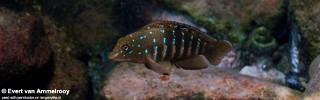
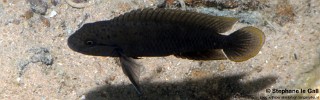
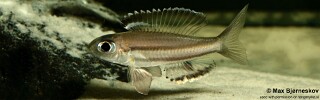
A characteristic feature noted for T. macrolepis is an orange to red stripe behind the eye, which is stated as absent in T. dhonti.
It is also stated that T. macrolepis does not show the characteristic orange-colored spot at the base of the pectoral fin reported for both male and female T. dhonti, and that even shell-dwelling forms of T. dhonti retain this orange spot.
Photo gallery