Albertville (Kalemie), Lake Tanganyika, Democratic Republic of Congo
Biotope:
Upper part of the rocky littoral zone close to the shoreline.
Strictly confined to extremely shallow, wave-exposed rocky habitats,
often in water less than one meter deep.
Adapted to turbulent conditions and not found outside these highly
wave-swept shallow zones.
Geographic distribution:
Populations regarded as true Spathodus erythrodon are those
found between Mtoa Bay and Cape Tembwe. It is possible that true S. erythrodon also occurs south of
Cape Tembwe toward Moba, but this has not been confirmed due to lack of documented records or photographs.
A similar species closely resembling true S. erythrodon occurs
on the opposite side of the lake in Tanzania between Isonga and Ikola
and is referred to as S. cf. erythrodon.
Typical adult size:
Up to about 8 cm total length; in aquaria individuals may grow slightly larger.
Females are typically 1–2 cm smaller than males.
Sexual dimorphism:
External sexual dimorphism is weak.
Females are smaller but otherwise similar in appearance to males.
Recommended aquarium size:
At least 300 L for a well-established pair.
For multiple individuals, aquaria of 500 L or more are required.
Aquarium setup:
Tank should be strongly structured with abundant rocks forming many
hiding places and visual barriers.
Fine sand substrate is recommended.
Strong water movement and high oxygenation are essential to simulate
natural wave-swept conditions.
Can be kept with other goby cichlids of different species, small
lamprologines (Julidochromis, Neolamprologus),
or open-water species such as Cyprichromis and
Benthochromis.
Diet:
Omnivorous aufwuchs feeder.
Feeds on algae and small invertebrates living within the aufwuchs.
Dentition and feeding strategy are intermediate between algae-scraping
Eretmodus and invertebrate-picking Tanganicodus.
Breeding:
Mouthbrooder with biparental incubation.
The female broods the eggs for approximately 12 days and then transfers
them to the male, who broods them for a further 10 days.
In some cases the male does not take over, and the female carries the
brood alone for the entire development period of about three weeks.
During such cases, the male may become aggressive toward the brooding
female and should be closely monitored in aquaria.
Aggression:
Extremely aggressive within the species, except in stable pairs.
Even established pairs may engage in frequent conflicts,
especially after loss of eggs or fry.
Aggression toward other species is comparatively low.
Special notes:
Several additional Spathodus-like forms occur in the central and
northern parts of Lake Tanganyika and are regarded by some authors
as potentially distinct species rather than simple geographical
variants.
These include forms known as Spathodus sp. 'erythrodon white zaire'
(from south of Moba toward at least Mwerazi), Spathodus sp.
'erythrodon tembwe' (Tembwe Deux), Spathodus sp.
'erythrodon isaba' (Isaba Point, south of Ikola), and a widely distributed
northern form referred to as Spathodus sp. 'erythrodon north'.
This latter form occurs on the Tanzanian shore north of Halembe and
extends through Burundi into the Ubwari region of Congo.
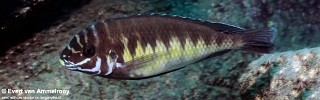
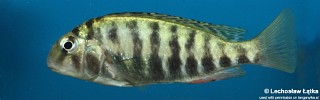
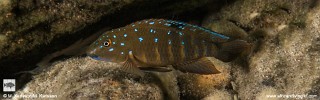
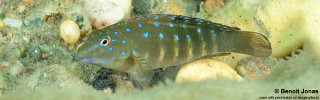
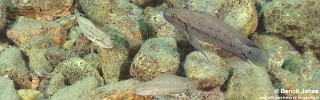



Strictly confined to extremely shallow, wave-exposed rocky habitats, often in water less than one meter deep.
Adapted to turbulent conditions and not found outside these highly wave-swept shallow zones.
A similar species closely resembling true S. erythrodon occurs on the opposite side of the lake in Tanzania between Isonga and Ikola and is referred to as S. cf. erythrodon.
Females are typically 1–2 cm smaller than males.
Females are smaller but otherwise similar in appearance to males.
For multiple individuals, aquaria of 500 L or more are required.
Fine sand substrate is recommended.
Strong water movement and high oxygenation are essential to simulate natural wave-swept conditions.
Can be kept with other goby cichlids of different species, small lamprologines (Julidochromis, Neolamprologus), or open-water species such as Cyprichromis and Benthochromis.
Feeds on algae and small invertebrates living within the aufwuchs.
Dentition and feeding strategy are intermediate between algae-scraping Eretmodus and invertebrate-picking Tanganicodus.
The female broods the eggs for approximately 12 days and then transfers them to the male, who broods them for a further 10 days.
In some cases the male does not take over, and the female carries the brood alone for the entire development period of about three weeks.
During such cases, the male may become aggressive toward the brooding female and should be closely monitored in aquaria.
Even established pairs may engage in frequent conflicts, especially after loss of eggs or fry.
Aggression toward other species is comparatively low.
These include forms known as Spathodus sp. 'erythrodon white zaire' (from south of Moba toward at least Mwerazi), Spathodus sp. 'erythrodon tembwe' (Tembwe Deux), Spathodus sp. 'erythrodon isaba' (Isaba Point, south of Ikola), and a widely distributed northern form referred to as Spathodus sp. 'erythrodon north'.
This latter form occurs on the Tanzanian shore north of Halembe and extends through Burundi into the Ubwari region of Congo.
Photo gallery