Shallow rocky shores covered with algae. Compared to most other members of the genus,
this species is more tolerant of rocks partially covered with sediment.
Geographic distribution:
Found south of the Lubulungu River, between Luagala Point and Cape Mpimbwe, along the
Tanzanian coast of Lake Tanganyika.
Typical adult size:
Around 14 cm total length in imported specimens, likely reaching a somewhat larger
size in aquaria.
Sexual dimorphism:
Dominant males are more intensely coloured than females and subordinate males.
Adult males display richer blue hues on the head and more contrasting markings.
Recommended aquarium size:
An aquarium of at least 500 liters is recommended.
Aquarium setup:
A rocky aquarium with ample grazing surfaces and territorial structure. Water should
be hard and alkaline (around pH 8.2) with strong filtration. Temperature should be
maintained between 23–26 °C.
Diet:
Feeds primarily on aufwuchs scraped from rocks. With its relatively reduced jaws,
it is among the less specialized algae grazers within the genus. In aquaria, the
diet should consist mainly of vegetable-based foods rich in spirulina. Due to the
long intestine, high-protein foods must be given only very sparingly.
Breeding:
Maternal mouthbrooder. After spawning, the female leaves the male’s territory and
broods independently. Egg numbers are relatively high at spawning (around 40),
decreasing during incubation to approximately 15–20. The incubation period may
last more than two months in community aquaria, during which the female feeds
delicately. Fry may either remain in the female’s mouth or temporarily shelter
nearby, returning to the mouth when threatened.
Aggression:
Considered one of the least aggressive Petrochromis species. Intraspecific aggression
is relatively low, making it suitable for mixed Tanganyika aquaria. Unlike
Tropheus, it does not exhibit fin-nipping behaviour.
Special notes:
Petrochromis sp. 'orthognathus ikola' resembles both Petrochromis orthognathus and
Petrochromis famula. It shares the cream-white and red-brown basic coloration with
P. orthognathus, while its longer snout is closer to that of P. famula. Vertical
bars remain visible even in adult specimens. The head shows striping similar to
P. orthognathus, but with a bluish hue, accompanied by additional blue-white
markings between the eye and the mouth.
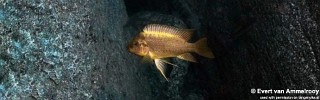
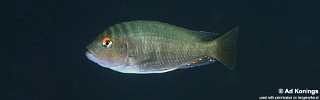
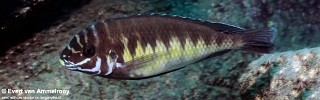
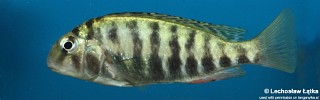
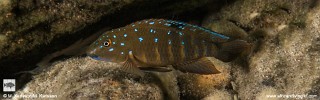



Photo gallery