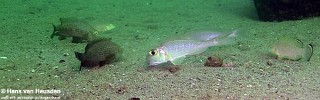
Shallow rocky littoral habitat, typically associated with rock surfaces covered by
dense growths of filamentous algae. Breeding sites are located on vertical rock
faces or within crevices, often well concealed from the surrounding area.
Geographic distribution:
Distributed along the shores of the southern half of Lake Tanganyika. On the west
coast the range extends from Kalemie southwards, while on the east coast it reaches
as far north as Cape Mpimbwe in Tanzania. The species is among the most common
cichlids in shallow rocky habitats in southern Zambia.
Typical adult size:
Up to 10 cm total length; in aquaria they can grow 2–3 cm larger.
Sexual dimorphism:
The species is described as monomorphic, with no external morphological differences
between males and females. Body shape and coloration are nearly identical, and the
size difference between the sexes is minimal, with males on average only a few
millimetres larger than females.
Recommended aquarium size:
Adult fish require a spacious aquarium; a minimum tank length of approximately
150 cm (around 400 litres) is recommended for species-appropriate care, providing
sufficient space for territorial behaviour and brood defence.
Aquarium setup:
The aquarium should be arranged to resemble a rocky littoral zone, using extensive
stone constructions that create crevices, overhangs, and small gaps. These structures
serve as territories, spawning sites, and shelters for fry.
Diet:
Examination of stomach contents revealed crustaceans, microorganisms, and filamentous
algae. The species feeds on small invertebrates associated with the algal growth
(aufwuchs) and also ingests algae incidentally. In the scientific literature it has
been variously classified as herbivorous, algivorous, or an omnivore with a strong
reliance on aufwuchs-associated fauna.
Breeding:
Biparental substrate breeder that spawns on concealed rock surfaces in shallow water.
Eggs are deposited on vertical faces or within crevices and hatch after a few days.
Both parents aggressively defend the brood, and brood care may last for up to about
three months, until juveniles reach approximately 3 cm. Broods of wild fish may
originate in synchrony with the lunar cycle, most frequently during the first
quarter moon.
Genetic studies have demonstrated multiple paternity within broods, indicating the
presence of alternative reproductive tactics, including sneaker males alongside
monogamous territorial males.
Aggression:
Strongly territorial, especially during brood care. Both parents actively defend their
territory against intruding fish. Territories may be complex, with each parent
defending separate sub-areas, and the total defended area typically ranges from
about 1 to 4 m² depending on depth and local conditions.
Special notes:
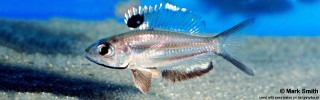
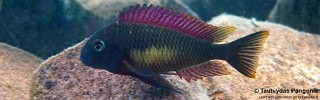
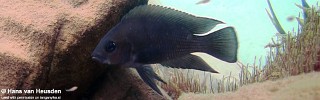
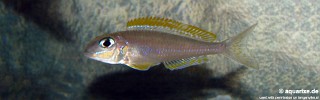
Juvenile coloration differs markedly from that of adults. Juveniles are often yellow,
beige, or orange, while adults are dark brown to black, usually with a narrow light
blue or white margin on the caudal, anal, and posterior dorsal fins. The size at
which juveniles change to adult coloration varies between populations, and some
populations retain bright juvenile coloration until near adulthood.
The species is notable for its high genetic differentiation between populations
despite pronounced morphological uniformity, a pattern interpreted as long-term
morphological stasis combined with limited dispersal and strong site fidelity.



Genetic studies have demonstrated multiple paternity within broods, indicating the presence of alternative reproductive tactics, including sneaker males alongside monogamous territorial males.
The species is notable for its high genetic differentiation between populations despite pronounced morphological uniformity, a pattern interpreted as long-term morphological stasis combined with limited dispersal and strong site fidelity.
Photo gallery