Intermediate sand-rock habitat.
Found at depths from 0 to 30 meters.
Geographic distribution:
All around the shores of Lake Tanganyika.
Typical adult size:
Up to 14 cm total length.
Sexual dimorphism:
Males are larger and more colorful than females,
usually bearing ocelli in the anal fin.
Recommended aquarium size:
300 L
Aquarium setup:
Aquarium of at least 150 cm length and 500 L volume or more.
Sand substrate is recommended, with rock structures arranged
to form passages and caves allowing females to hide.
Adequate open swimming space should be maintained.
Best kept with several females per male and not housed
with aggressive cichlid species.
Diet:
Carnivorous.
Predatory species feeding mainly on shrimps
(reported up to 80% of the diet) and other invertebrates,
as well as small fishes.
Breeding:
Maternal mouth-brooder.
Produces small clutches of 10–20 large eggs.
The male defends a temporary territory but does not build a nest.
Females incubate the brood alone for three weeks or more.
Aggression:
Intraspecific aggression can be pronounced,
but the species is generally tolerant toward other cichlids.
Special notes:
A predatory haplochromine with a strongly compressed body and
a stretched, pointed mouth.
Grey-brown coloration with vertical barring and yellowish hints
is characteristic. The caudal fin is triangular with a straight
posterior edge. Taxonomic history includes former placement in
Limnochromis, Haplochromis, and Gnathochromis before recognition
as the distinct genus Jabarichromis.
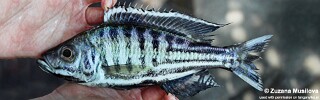
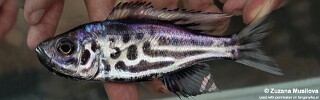
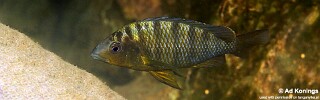
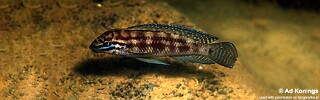
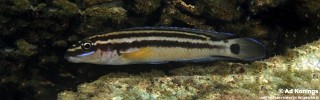
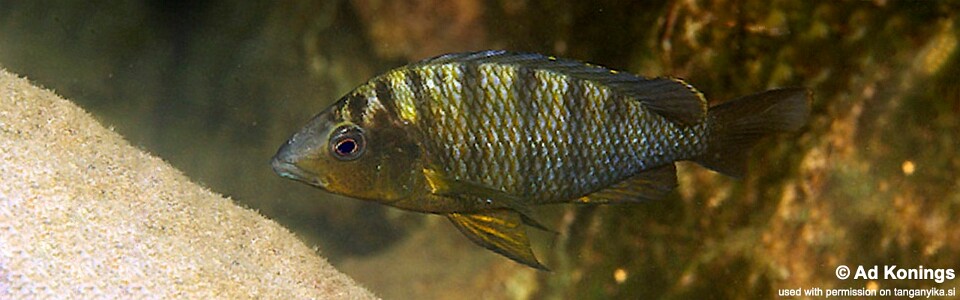




Photo gallery