Moba Bay, south of Mtoto, Lake Tanganyika, Democratic Republic of Congo
Biotope:
Sandy and muddy bottoms in the open sandy habitat of Lake Tanganyika.
Most commonly found at depths of 50–75 m, with records down to
100 m. Rarely encountered shallower than 35 m, except near
river outlets.
Geographic distribution:
Endemic to Lake Tanganyika with a lake-wide distribution, recorded from
the Congolese, Tanzanian, Burundian, and Zambian shores.
Typical adult size:
The only species of Xenotilapia in which females grow larger than
males. Males average around 10.5 cm SL (maximum about 13.6 cm),
while females average around 12 cm SL and may reach up to
15.6 cm.
Sexual dimorphism:
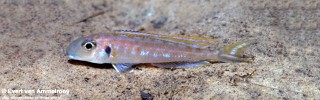
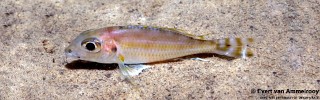
Females are larger and generally silvery with a faint bluish hue in the
dorsal fin. Males display horizontal brownish lines along the flanks,
black bars on the caudal fin, and black margins on the dorsal, anal and
ventral fins. Sexually active males develop a pitch-black throat.
Recommended aquarium size:
At least 400 liters, with a minimum aquarium length of about
150 cm for long-term maintenance.
Aquarium setup:
Fine sand substrate is essential. Smooth rocks should be placed mainly in
the background to provide shelter, ensuring that no sharp edges are
present due to the species’ large and fragile eyes. Open swimming space
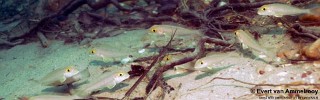
is important, as this species spends much of its time in mid-water.
Diet:
Carnivorous. Feeds mainly on invertebrates, especially chironomid larvae,
as well as ostracods, diatoms, and other small benthic organisms. Feeding
involves rapid thrusts into the substrate, lifting mouthfuls of sand
that are filtered for edible items before non-edible material is
expelled through the mouth and gills.
Breeding:
Maternal mouthbrooder. Males do not construct sand-scrape spawning sites
and attempt to spawn at random locations. Courtship is intense and
continuous, involving vigorous displays with spread fins and rapid lip
movements. Females lay cream-colored, slightly oval eggs of about
3 mm, usually fewer than 40 per clutch. Females incubate eggs and
larvae for approximately three weeks and provide no post-release brood
care.
Aggression:
Generally peaceful toward other species. Males encourage displays and mild
competition, but overall aggression levels are relatively low compared
to many other Xenotilapia.
Special notes:
Unique within the genus in having females larger than males and a
distinct dentition, with outer teeth oriented vertically rather than
horizontally. This dental specialization is associated with a different
feeding strategy compared to other Xenotilapia species.
Although its dentition once raised doubts about its generic placement,
both morphological and molecular studies confirm that its closest
relatives lie within Xenotilapia.




Although its dentition once raised doubts about its generic placement, both morphological and molecular studies confirm that its closest relatives lie within Xenotilapia.
Photo gallery