Albertville [Kalemie], Lake Tanganyika, Zaire [Democratic Republic of Congo].
Biotope:
Intermediate habitat between sandy and rocky environments. The species is frequently found
in shallow waters over sandy or muddy bottoms, but may also occur at greater depths, ranging from
less than 10 metres down to approximately 60 metres.
Geographic distribution:
A widespread species occurring along the shoreline of Lake Tanganyika.
Typical adult size:
Males typically reach about 18–20 cm in the wild and may grow up to 25 cm in aquaria.
Females are approximately 20% smaller. Populations from Zambia are reported to be notably smaller,
reaching around 14 cm, whereas the largest specimens are reported from the Kipili Archipelago
in Tanzania.
Sexual dimorphism:
Males are larger than females; otherwise, the sexes are very similar in appearance.
Recommended aquarium size:
At least 500 L. For community aquaria, a tank length of approximately 200 cm is recommended.
Aquarium setup:
Due to its large size and pronounced aggression during breeding, this species is relatively
uncommon in aquaria.
Provide a sandy substrate with several large rocks placed directly on the tank bottom before adding
sand, as the fish frequently excavate and may otherwise undermine unstable rockwork.
In sufficiently large aquaria (recommended length at least 200 cm), it may be kept together with
other large Tanganyika cichlids. Smaller cichlids (below approximately 10 cm) should not be housed
together with this species, as they may be preyed upon. The species is best kept as a pair or as one
male with several females.
Diet:
Carnivorous. A predatory species feeding mainly on smaller fishes, as well as on various
invertebrates including crustaceans and snails.
Breeding:
In the lake, the species often lives in harems, although pairs may form where predation
pressure is high. Both males and females maintain and defend territories.
Spawning takes place within the female’s territory. The female prepares a nest near rocks by
excavating sand beneath them. Eggs are numerous, typically around 100–200, and are often deposited
on relatively open substrate where they may be visible from outside, unlike the concealed clutches
of smaller species.
After the fry become free-swimming, brood care is usually performed by the female alone, although
both parents may participate if predation pressure is high.
Aggression:
Intraspecific aggression can be pronounced. The species also becomes highly aggressive toward
other fishes during brood defence.
Special notes:
Neolamprologus tetracanthus is a large, slender-bodied lamprologine and is the type
species of the genus Neolamprologus. It is only exceeded in size within the genus by
N. cunningtoni.
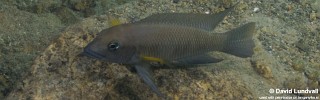
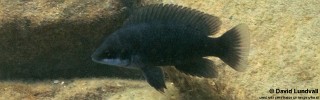
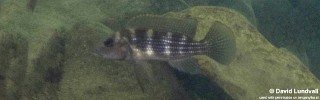
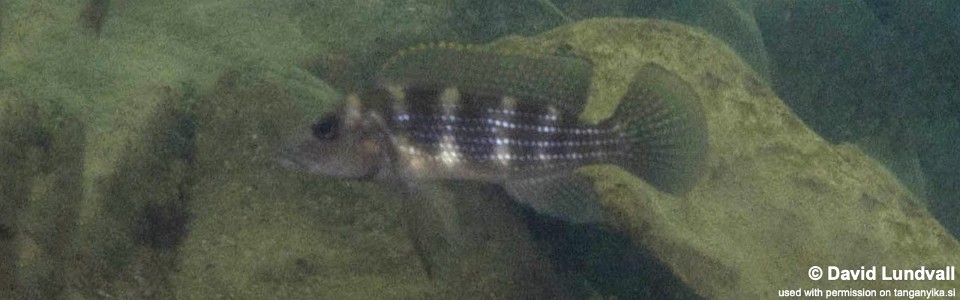
The species is brownish yellow in overall coloration, with rows of white dots on the lateral scales.
The unpaired fins are rounded and edged with yellow-white, black, and sometimes red, particularly in
northern populations. A distinctive diagnostic feature is the presence of only four anal spines,
which is exceptional among lamprologines.
Taxonomically, N. brevianalis, N. marginatus, and N. tetracanthus are very
similar. Some authors treat them as a single species with geographically distinct variants, and the
Catalog of Fishes currently lists N. brevianalis and N. marginatus as junior
synonyms of N. tetracanthus; this approach is also followed on tanganyika.si.
Some other authors, including African Diving, consider all three to be valid species.
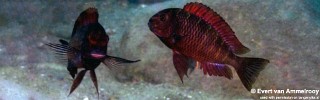
Reported distinguishing characters include colour differences: N. brevianalis is noted for
its yellow lips, whereas N. tetracanthus is characterised by a red margin on the dorsal fin,
along with additional, more subtle differences. Exact distributional boundaries between these taxa
remain unclear.



Provide a sandy substrate with several large rocks placed directly on the tank bottom before adding sand, as the fish frequently excavate and may otherwise undermine unstable rockwork.
In sufficiently large aquaria (recommended length at least 200 cm), it may be kept together with other large Tanganyika cichlids. Smaller cichlids (below approximately 10 cm) should not be housed together with this species, as they may be preyed upon. The species is best kept as a pair or as one male with several females.
Spawning takes place within the female’s territory. The female prepares a nest near rocks by excavating sand beneath them. Eggs are numerous, typically around 100–200, and are often deposited on relatively open substrate where they may be visible from outside, unlike the concealed clutches of smaller species.
After the fry become free-swimming, brood care is usually performed by the female alone, although both parents may participate if predation pressure is high.
The species is brownish yellow in overall coloration, with rows of white dots on the lateral scales. The unpaired fins are rounded and edged with yellow-white, black, and sometimes red, particularly in northern populations. A distinctive diagnostic feature is the presence of only four anal spines, which is exceptional among lamprologines.
Taxonomically, N. brevianalis, N. marginatus, and N. tetracanthus are very similar. Some authors treat them as a single species with geographically distinct variants, and the Catalog of Fishes currently lists N. brevianalis and N. marginatus as junior synonyms of N. tetracanthus; this approach is also followed on tanganyika.si. Some other authors, including African Diving, consider all three to be valid species.
Reported distinguishing characters include colour differences: N. brevianalis is noted for its yellow lips, whereas N. tetracanthus is characterised by a red margin on the dorsal fin, along with additional, more subtle differences. Exact distributional boundaries between these taxa remain unclear.
Photo gallery