Mbity Rocks and Kinyamkolo (Mpulungu), Lake Tanganyika, Zambia
Biotope:
Rocky and intermediate habitats.
Geographic distribution:
Neolamprologus modestus occurs along the Zambian coast of Lake Tanganyika, with confirmed populations between Cape Chipimbi and Nkamba Bay,
and further south between Mbete Bay (Zambia) and Kilewani (Tanzania). Populations attributed to Neolamprologus cf. modestus are restricted to the Tanzanian
coast and occur between Kasanga and Mbofula Points.
Typical adult size:
Up to approximately 12 cm total length.
Sexual dimorphism:
No clear sexual dimorphism in coloration; males are larger than females and
develop a more pronounced frontal hump.
Recommended aquarium size:
200 L for a well-established pair.
Aquarium setup:
The aquarium should contain several larger rock structures, with fine sand on
the bottom. Compared to the similar but more slender Neolamprologus christyi,
this species is generally calmer, although it defends its territory very
vigorously, especially when guarding eggs or fry. A tank of at least 200 L is
recommended for a bonded pair; larger aquaria are required for community setups.
Diet:
Carnivorous. Feeds mainly on various invertebrates and occasionally on small
snails.
Breeding:
Breeds throughout the year and shows a high reproductive output, with clutches
ranging from approximately 200 to 500 eggs. According to Ad Konings (2015),
males often live in harems with two to five females in the wild. In aquarium
conditions, however, the species usually forms pairs, with the male being
relatively tolerant towards the female.
Aggression:
Considerably calmer than Neolamprologus christyi, but still strongly
territorial, especially during breeding and while guarding eggs or fry.
Special notes:
Neolamprologus modestus is very similar to Neolamprologus petricola,
and some authors consider both to represent the same species. In his most recent
work (2015), Ad Konings treats N. petricola as a synonym of
N. modestus. Until this is conclusively resolved, it is appropriate to
regard them as two valid species. Differences between the two are subtle:
N. petricola has a deeper body and adult males show a more pronounced
frontal hump, whereas N. modestus has a shallower body profile.
Both species are cream-beige in coloration, but depending on environmental
conditions they may darken considerably to brown. They also resemble
Neolamprologus mondabu, which led to long-standing taxonomic confusion.
N. modestus and N. petricola can be clearly separated from
N. mondabu by their rounded caudal fin, whereas the caudal fin of
N. mondabu is always pointed and straight to crescent-shaped, though less
deeply forked than in Neolamprologus christyi or
Neolamprologus sp. ‘eseki’. Distribution limits between
N. modestus and N. petricola remain unclear, and their ranges may
overlap or meet somewhere along the western Zambian coast.
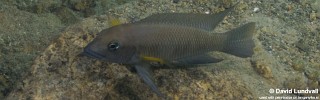
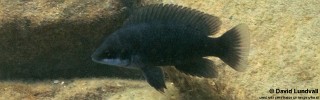
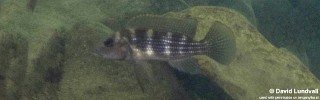



Both species are cream-beige in coloration, but depending on environmental conditions they may darken considerably to brown. They also resemble Neolamprologus mondabu, which led to long-standing taxonomic confusion. N. modestus and N. petricola can be clearly separated from N. mondabu by their rounded caudal fin, whereas the caudal fin of N. mondabu is always pointed and straight to crescent-shaped, though less deeply forked than in Neolamprologus christyi or Neolamprologus sp. ‘eseki’. Distribution limits between N. modestus and N. petricola remain unclear, and their ranges may overlap or meet somewhere along the western Zambian coast.
Photo gallery