Between Cape Bwana Denge and Moni, Lake Tanganyika.
Biotope:
Deep muddy habitats, typically below 40–60 m.
Collected mostly between 50 and 125 m depth.
Likely digs complex tunnels in soft substrate, similar to other limnochromines.
Geographic distribution:
Endemic to Lake Tanganyika. Described from specimens collected between Cape Bwana Denge
and Moni (DR Congo and Tanzania). Additional records include Mtoto and Moba on the central
Congolese coast, Msamba and the outlet of the Malagarazi River in Tanzania, as well as
Zambia. Imports from Burundi suggest a lake-wide distribution.
Typical adult size:
Around 19 cm TL in the wild; can reach at least 25 cm in the aquarium.
Sexual dimorphism:
Very weak. Males tend to grow slightly larger than females, as typical for biparental
mouthbrooders.
Recommended aquarium size:
Minimum length 150 cm for a single pair; very large aquaria required during breeding.
Aquarium setup:
Thick layer of fine sand with numerous caves and tunnels made from rocks or PVC pipes.
Due to extreme aggression during pair formation and spawning, tankmates must be chosen
with great care and may need to be removed entirely when breeding occurs.
Diet:
Carnivorous predator. Feeds mainly on snails, but also large shrimps and fish.
Snails are crushed using large molariform pharyngeal teeth, a behavior readily observed
in the aquarium.
Breeding:
Biparental mouthbrooder. Spawning takes place in a tunnel or cave dug in sand or mud.
The male releases sperm inside the tunnel and leaves; the female then enters alone,
lays eggs and immediately picks them up. Fertilization occurs in the water containing
the male’s seminal fluids. Parents exchange eggs and larvae for about two weeks, usually
in a meticulously cleaned pit. Fry become free-swimming thereafter but are guarded and
taken back into the mouth at night. Clutch size at least 300 eggs.
Aggression:
Extremely aggressive, especially during pair formation and breeding.
Capable of excluding or killing tankmates even in very large aquaria.
Special notes:
Differs from its close relative Greenwoodochromis abeelei by having a deeper body,
fewer longitudinal scales (35–36 vs. 38–39), and smaller eyes.
Unpaired fins are adorned with numerous small iridescent blue spots, unlike the fewer,
larger spots seen in G. abeelei, which are mainly confined to the dorsal fin and
upper caudal fin. A large, powerful and behaviorally fascinating species best suited for
experienced aquarists with very large aquaria.
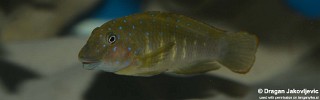
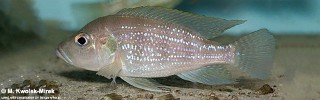
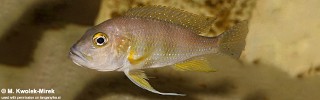
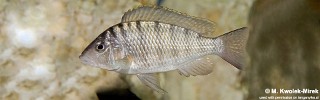
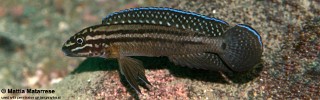



Photo gallery