Deep-water habitats, primarily deep rocky areas and transitional zones between rocks and mud.
Found at depths greater than 25 m, down to at least 100 m.
Geographic distribution:
Endemic to Lake Tanganyika. Likely lake-wide in suitable habitats.
Originally known only from three type specimens of unknown locality; later recorded from
southeastern Lake Tanganyika (Zambia) and from the extreme northern parts of the lake
in the Democratic Republic of Congo and Burundi. Underwater observations include Samazi
(Tanzania) and Chituta Bay (Zambia).
Typical adult size:
Males up to about 18 cm; females usually up to about 15 cm.
Sexual dimorphism:
Weakly developed. Males grow slightly larger and develop longer fins.
Females have a rounder belly when ripe and tend to show more iridescence
on the anterior part of the body.
Recommended aquarium size:
Minimum 400 L.
Aquarium setup:
Fine sand substrate with rockwork forming caves and tunnels.
Lighting should be subdued to reflect its deep-water origin.
Best kept as a single bonded pair due to strong intraspecific aggression.
If kept with other species, only large and robust Tanganyikan cichlids
should be chosen, and the aquarium should be significantly larger.
Diet:
Carnivorous predator. Likely feeds on small fish and shrimps in nature.
In the aquarium accepts frozen and live foods such as mysis, krill, artemia,
chopped fish, shrimps and mussels. Smaller tankmates may be ignored during
the day but are often preyed upon at night.
Breeding:
Biparental mouthbrooder. Spawning takes place in a cave dug in sand or mud under rocks.
Parents exchange eggs and larvae for about two weeks; the female incubates mainly at the
beginning, while the male takes over towards the end. Free-swimming fry are still guarded
and often taken back into the mouth at night. Clutch size may reach at least 200 eggs.
Aggression:
Very aggressive towards conspecifics; only one established pair should be kept.
Highly predatory towards smaller fishes. Generally less aggressive towards large,
non-competing Tanganyikan cichlids.
Special notes:
Closely related to Greenwoodochromis bellcrossi, from which it differs by having
larger scales (44–50 vs. 51–58), a less laterally compressed body, smaller eyes,
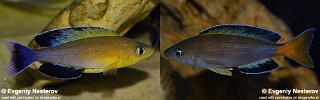
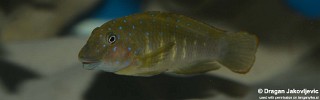
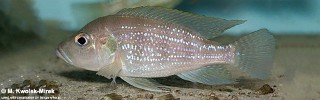
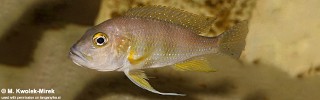
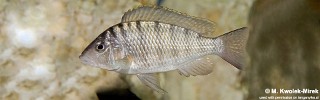
and a moderately (rather than extremely) inclined mouth. Live specimens are typically
grey to brownish, lacking the bronze-yellow sheen of G. bellcrossi.
Juveniles may dig and defend small pits in the substrate, a behavior also observed in
G. bellcrossi and G. staneri, likely serving as protection
against predators in open deep-water habitats.



Juveniles may dig and defend small pits in the substrate, a behavior also observed in G. bellcrossi and G. staneri, likely serving as protection against predators in open deep-water habitats.
Photo gallery