Shallow, wave-exposed and well-oxygenated rocky habitats, rarely deeper than three metres.
The habitat may include rocky areas with sediment-rich patches; the species is adapted to turbulent conditions
through reduced buoyancy and frequently rests on rocks rather than engaging in prolonged swimming.
Geographic distribution:
Southern Tanzania, restricted to the Udachi area and surrounding localities, including Kabwe and
Kanchui.
Typical adult size:
Up to approximately 7 cm total length.
Sexual dimorphism:
Not externally apparent; sexes are visually similar.
Diet:
Primarily an invertebrate picker, screening rocky habitats for small invertebrates.
Breeding:
Biparental mouthbrooder. The female broods the eggs and early larvae for approximately 10–15 days,
after which the male takes over brooding the larvae for a further 10–15 days.
During mouthbrooding, the brooding parent does not feed, and pairs are permanently bonded.
Aggression:
Not specifically documented; as with other goby cichlids, strong pair bonding and territorial
behaviour are implied.
Special notes:
The southernmost known Tanganicodus population in Tanzania and regarded as a potentially
distinct species, referred to as Tanganicodus sp. 'irsacae udachi'.
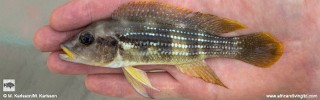
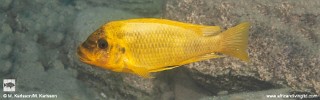
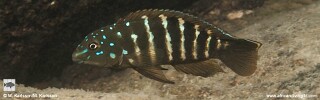
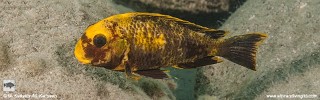
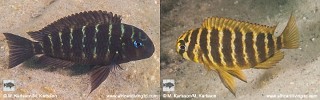
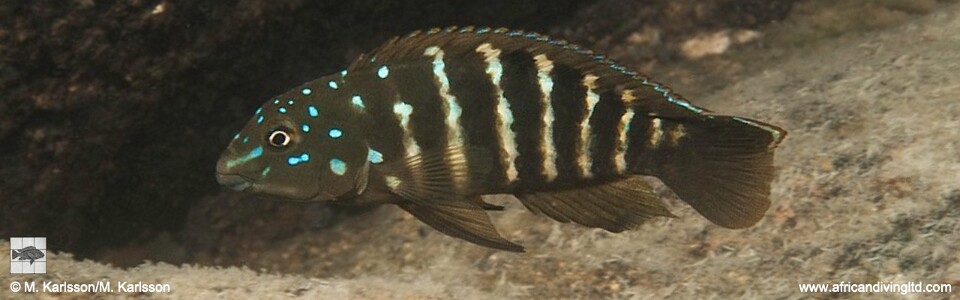
It is distinguished from most other T. irsacae-like populations by fully extended yellowish body bars
on the trunk and the absence of blue dots on the adult body (blue dots may be present in juveniles).
Unlike many northern T. irsacae-like populations, this form lacks a distinct black dorsal fin spot.
Tooth morphology remains the most reliable character for distinguishing Tanganicodus from similar
Spathodus species in the same region.



The habitat may include rocky areas with sediment-rich patches; the species is adapted to turbulent conditions through reduced buoyancy and frequently rests on rocks rather than engaging in prolonged swimming.
During mouthbrooding, the brooding parent does not feed, and pairs are permanently bonded.
It is distinguished from most other T. irsacae-like populations by fully extended yellowish body bars on the trunk and the absence of blue dots on the adult body (blue dots may be present in juveniles).
Unlike many northern T. irsacae-like populations, this form lacks a distinct black dorsal fin spot. Tooth morphology remains the most reliable character for distinguishing Tanganicodus from similar Spathodus species in the same region.
Photo gallery