A small rocky and rubble zone adjacent to gently sloping shore areas composed of gravel,
stones, and boulders. In slightly steeper sections, layered stones form numerous small caves that
serve as hiding places and breeding sites.
Between the rocky and sandy areas, aquatic vegetation develops, including Vallisneria,
Myriophyllum spicatum, Hydrilla verticillata, and Chara spp. From depths of
about six meters, rocky rubble transitions into extensive Chara fields, which may reach
over one meter in height and extend toward open water, ending at depths between seven and twelve
meters.
Geographic distribution:
Restricted to a very small stretch of shoreline at Kombe, Zambia, in the southernmost part
of Lake Tanganyika. The known distribution is limited to less than two to three kilometers of coast.
The species has not been found northward at Chezi nor beyond the sandy Mbete Bay to the south, which
forms a barrier for less mobile cave-dwelling species.
Special notes:
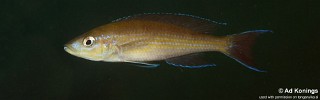
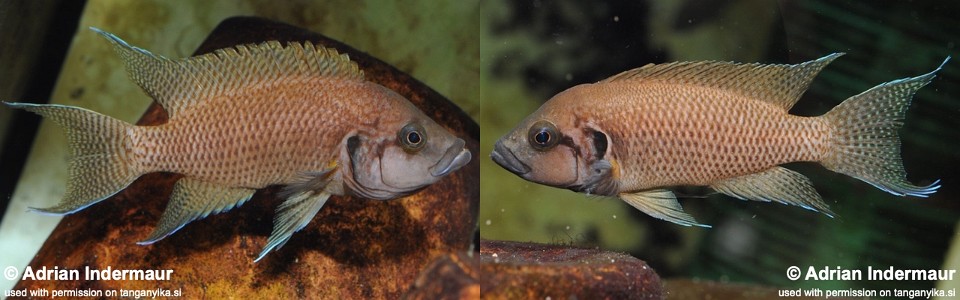
Originally discussed as a possible natural hybrid between N. savoryi and
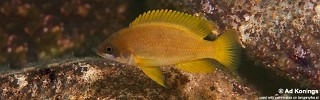
N. pulcher, this localized form has been referred to as Neolamprologus sp. ‘kombe’.
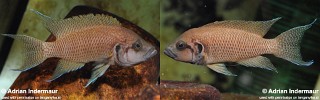
It shows phenotypic similarities to both species, including body coloration and pattern elements.
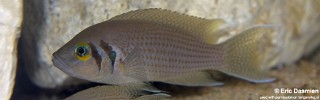
Gill-cover and head stripe patterns differ from typical N. savoryi and resemble traits known
from N. pulcher, although individual variation occurs. Light blue fin margins, characteristic
of N. pulcher, have also been observed.
Genetic investigations conducted within the framework of the ‘Cichlid-X’ Project indicate that this
form is genetically distinct from N. savoryi, N. pulcher, and other members of the
N. brichardi group, excluding its interpretation as a simple color variant. The population
forms a closed reproductive community and occurs sympatrically with one presumed parent species,
while remaining reproductively isolated. The evolutionary mechanisms maintaining this separation
remain unresolved.




Between the rocky and sandy areas, aquatic vegetation develops, including Vallisneria, Myriophyllum spicatum, Hydrilla verticillata, and Chara spp. From depths of about six meters, rocky rubble transitions into extensive Chara fields, which may reach over one meter in height and extend toward open water, ending at depths between seven and twelve meters.
Gill-cover and head stripe patterns differ from typical N. savoryi and resemble traits known from N. pulcher, although individual variation occurs. Light blue fin margins, characteristic of N. pulcher, have also been observed.
Genetic investigations conducted within the framework of the ‘Cichlid-X’ Project indicate that this form is genetically distinct from N. savoryi, N. pulcher, and other members of the N. brichardi group, excluding its interpretation as a simple color variant. The population forms a closed reproductive community and occurs sympatrically with one presumed parent species, while remaining reproductively isolated. The evolutionary mechanisms maintaining this separation remain unresolved.
Photo gallery