Sediment-rich rocky habitat.
Occurs at depths of approximately 5–30 meters.
Geographic distribution:
Endemic to Lake Tanganyika.
Known from the Kombe locality.
A closely related population is reported from Kalala village,
approximately 16 km north of Kombe, and is here included together
with the Kombe population.
Typical adult size:
Up to approximately 8 cm total length.
Recommended aquarium size:
100 L for a bonded pair
Aquarium setup:
Fine sand substrate with extensive rockwork arranged to form numerous caves and hiding places.
Only one pair should be kept per aquarium.
Best results are achieved by starting with a group of 5–6 juveniles
and removing excess individuals once a pair forms.
Once established, the pair becomes strongly territorial.
Can be kept with other Tanganyikan cichlids of similar size
that occupy different aquarium zones.
Diet:
Omnivorous.
Feeds on various invertebrates and small aquatic insects picked from algae and aufwuchs.
Sponges are also part of the natural diet.
Breeding:
Cave spawner.
Breeds year-round, approximately every three weeks.
Clutch size is variable, ranging from about 10 to 80 eggs.
Both parents actively guard eggs and fry.
Aggression:
High intraspecific aggression,
particularly during territorial defense.
Aggression toward other species mainly occurs around the breeding territory.
Special notes:
There has been long-standing confusion surrounding Julidochromis from Kombe and Katoto.
The name “Gombe” used in the aquarium trade refers to a misspelling of the village Kombe,
as no village named Gombe exists in Zambia.
This confusion led to the widespread export name “Gombi Transcriptus”
and frequent mixing of fish from different localities in the hobby.
Julidochromis from Kombe and Katoto are considered distinct,
despite having often been treated under the same name.
In the wild, the Kombe population is typically much darker than aquarium specimens.
Classification has varied widely, with past assignments to
Julidochromis transcriptus,
dwarf forms of J. marlieri,
or ornatus-related lineages.
Ad Konings currently considers the Kombe and Katoto populations
to be closely related to J. ornatus and for this reason
uses the name Julidochromis sp. ‘ornatus kombe’.

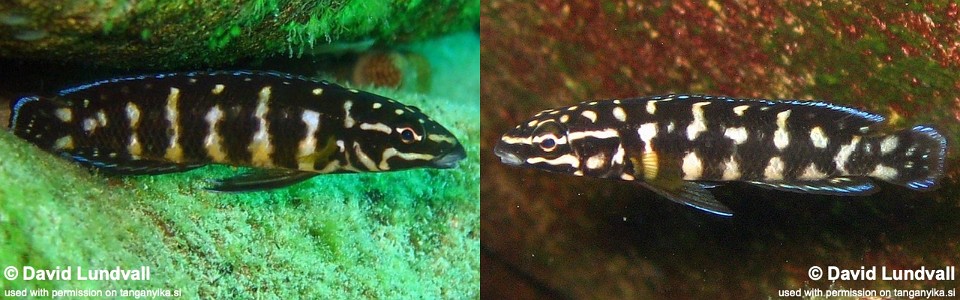



Photo gallery