Observed in a pure rocky habitat at Fulwe Rocks at around 10 m depth. The rocky
habitat at Fulwe Rocks extends down to about 40–50 m, but this species was not
searched for at those depths. Individuals appear to be highly territorial and rarely
venture far from their rocky hideouts.
Geographic distribution:
Only observed at Fulwe Rocks.
Typical adult size:
Elongate caudal-fin lobes measure approximately 10–15 mm in adult individuals.
Sexual dimorphism:
Diagnostic characteristics are primarily based on adult individuals; juveniles may
differ in appearance and are more difficult to distinguish.
Special notes:
Temporarily regarded as a new princess-like species discovered in May 2008 at
Fulwe Rocks by African Diving Ltd and referred to as Neolamprologus sp.
“Savoryi Fulwe”. In several morphological characters it resembles N. savoryi,
while behaviourally it has been compared to N. sp. “Cygnus”.
Characterised by an elongated, brown, non-barred body; brown finnage; and a lunate
caudal fin with elongate lobes. The head is large with a straight-sloping upper
profile and seemingly protruding jaws. Facial colour pattern is semi-unique among
princess-like species and includes opercular ornamentation, notably a conspicuous
single thick black vertical stripe along the edge of the operculum, along with a few
subdued brownish spots behind the eye. A yellow edge is present at the posterior
part of the dorsal fin and on the upper caudal-fin lobe.
Temporarily separated from N. savoryi primarily by its longer body, as well as
differences in body and fin coloration, longer caudal-fin lobes, facial colour
pattern, and the absence of numerous thick vertical bars on the flanks. It differs
from N. sp. “Cygnus” by the presence of an opercular marking and, compared to
the Fulwe Rocks variant of N. sp. “Cygnus”, by the absence of a yellow pectoral
spot; N. sp. “Cygnus” is also reported to show a more pronounced black margin
on the pelvic and anal fins.
Considered a likely young species that has recently begun adapting to a more
modern and distinct ecological niche at Fulwe Rocks. An alternative hypothesis
mentioned is that it could represent a hybrid between N. savoryi and
N. sp. “Cygnus”. The species has been observed living sympatrically with
N. sp. “Cygnus” and N. brichardi at Fulwe Rocks; typical N. savoryi
was not observed there, although the locality was not explored at greater depths.
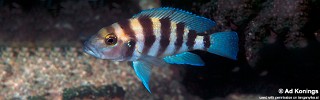
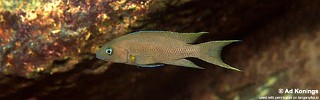
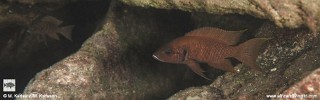
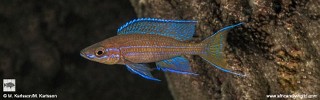
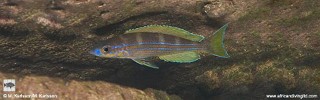
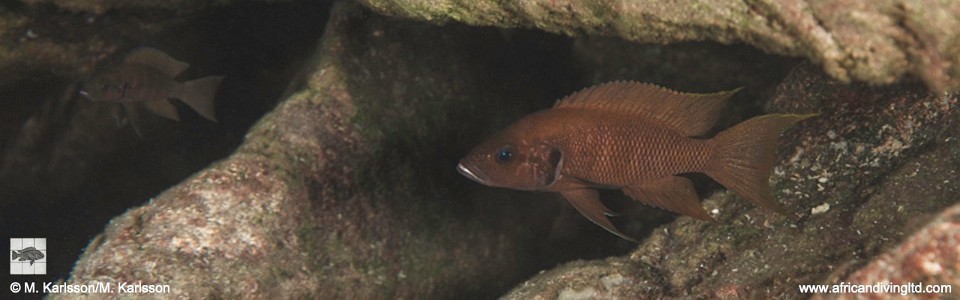



Characterised by an elongated, brown, non-barred body; brown finnage; and a lunate caudal fin with elongate lobes. The head is large with a straight-sloping upper profile and seemingly protruding jaws. Facial colour pattern is semi-unique among princess-like species and includes opercular ornamentation, notably a conspicuous single thick black vertical stripe along the edge of the operculum, along with a few subdued brownish spots behind the eye. A yellow edge is present at the posterior part of the dorsal fin and on the upper caudal-fin lobe.
Temporarily separated from N. savoryi primarily by its longer body, as well as differences in body and fin coloration, longer caudal-fin lobes, facial colour pattern, and the absence of numerous thick vertical bars on the flanks. It differs from N. sp. “Cygnus” by the presence of an opercular marking and, compared to the Fulwe Rocks variant of N. sp. “Cygnus”, by the absence of a yellow pectoral spot; N. sp. “Cygnus” is also reported to show a more pronounced black margin on the pelvic and anal fins.
Considered a likely young species that has recently begun adapting to a more modern and distinct ecological niche at Fulwe Rocks. An alternative hypothesis mentioned is that it could represent a hybrid between N. savoryi and N. sp. “Cygnus”. The species has been observed living sympatrically with N. sp. “Cygnus” and N. brichardi at Fulwe Rocks; typical N. savoryi was not observed there, although the locality was not explored at greater depths.
Photo gallery