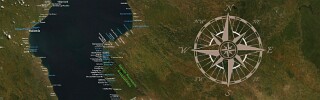
Lake Tanganyika is the second-largest African lake by surface area, covering 32,900 km².
The largest African lake is Lake Victoria (68,800 km²), while Lake Malawi follows closely behind Tanganyika
with 29,600 km². Lake Tanganyika is also considered exceptionally clean (with a very low number of microbes)
and offers impressive underwater visibility of up to 20 m.
It is also extremely deep: the average depth is about 570 m and the maximum depth reaches up to 1,470 m.
As a result, the total water volume is far greater than in the other two African Great Lakes.
Lake Tanganyika contains approximately 18,900 km³ of water (Lake Victoria 2,750 km³, Lake Malawi 8,400 km³).
Despite its depth, Tanganyika cichlids are found only down to around 250 m, because deeper layers lack oxygen
and cannot support life.
So what are the key water characteristics (temperature, hardness, pH, etc.) in Lake Tanganyika?
Compared with typical tap water, a major “Tanganyika” signature is that carbonate hardness (KH) is higher than
total hardness (GH). In many tap waters, KH is usually around 80% of GH (for example, if total hardness is
15°dGH, carbonate hardness is typically about 12°dKH).
The goal of every responsible aquarist is to provide fish with the best possible approximation of their natural
environment. Besides aquarium size and layout, water quality is undoubtedly one of the most important factors.
Of course, we cannot fully replicate nature, because an aquarium is a closed system (and the same is true for the water).
Fish can adapt to certain deviations, but these should not be excessive.
For wild-caught fish (imported directly from the lake), it is recommended to match parameters as closely as possible
to the natural ones (which is not always easy). For captive-bred fish, some deviation is acceptable, as many species
have been bred in aquariums for generations and are partly adapted to “aquarium water.”
The table below shows typical Lake Tanganyika values and recommended/acceptable aquarium values.
If you are not experienced and your tap water does not deviate much from the recommended range, do not “over-tune”
every parameter—stable conditions are usually better than chasing ideal numbers and causing fluctuations.
Core Water Parameters
Tanganyika
Lake values
Aquarium values
Temperature
24°C to 27°C
25°C to 26°C
pH
8.3 to 9.2
8.0 to 9.5
Total hardness (GH)
10°dGH to 13°dGH
8°dGH to 20°dGH
Alkalinity (“aquarium” KH)
16°dKH to 19°dKH
11°dKH to 22°dKH
Conductivity
570 µS/cm to 640 µS/cm
up to 1100 µS/cm
Temperature
The best approach is to keep Tanganyika cichlids at temperatures similar to those in the lake.
Seasonal temperature changes in Lake Tanganyika are small. In the aquarium, it is safest to aim for mid-range
values within the lake’s spectrum (see the table above).
Tanganyika cichlids (like other African cichlids) do not tolerate high temperatures well.
At higher temperatures fish may become more active (often also more aggressive), metabolism increases
(and so does food demand), and breeding may intensify. However, the critical risk is oxygen shortage:
at higher temperatures oxygen dissolves less effectively in water. This often shows as rapid gill movement
and gasping at the surface.
Fish can tolerate around 30°C for a short period, but prolonged exposure—and especially temperatures above 30°C—
can quickly become fatal. At recommended temperatures (around 25°C), fish remain active but generally less aggressive,
and they will still breed without problems. At excessively low temperatures fish may enter a type of “hibernation,”
which is also undesirable. Stick to the recommended range.
pH
pH tells us whether water is acidic or alkaline. It is measured on a scale from 0 to 14:
7.0 is neutral, values below 7.0 are acidic, and values above 7.0 are alkaline.
Tanganyika cichlids require alkaline water (above 7.0).
pH in water is mainly influenced by carbonate hardness (KH) and the concentration of carbon dioxide (CO₂).
Because CO₂ levels change as biological processes occur in the aquarium, pH can change as well.
Higher KH (buffering capacity) generally means a more stable pH.
pH can be adjusted in several ways. It can be lowered by adding RO (reverse osmosis) water, which reduces KH
(and GH) and therefore tends to lower pH. For Tanganyika aquariums this is usually unnecessary, because tap water
commonly has suitable KH—or even lower KH than the lake.
If pH is too low, it can be increased with buffers that raise KH. This may be relevant if your water is very soft
with low KH (which is uncommon in many regions).
For Tanganyika setups, one example is Seachem Tanganyika Buffer, which increases alkalinity (“aquarium KH”)
without raising GH. There are many other products and approaches, but unless pH is clearly outside an acceptable
range (especially if it is acidic), avoid “playing” with pH—particularly if you lack experience.
It is easy to accidentally change other parameters or cause unstable swings.
A stable pH that is slightly off-target is usually safer than a pH that constantly fluctuates.
Water Hardness
Water hardness is very important for fish health. It affects osmoregulation and calcium regulation in the blood.
It can also influence the toxicity of certain minerals and pesticides. In general, harder water reduces the toxicity
of many substances, though there are exceptions—ammonia, for example, is far more toxic in alkaline water (higher pH)
than in soft, acidic water.
For Tanganyika cichlids it is clear: the water should be hard. We distinguish between total hardness (GH) and
carbonate hardness (KH). A particularly interesting feature of Lake Tanganyika is that KH is higher than GH.
Total hardness (GH)
Total hardness is a measure of the concentration of alkaline earth metal ions in water, regardless of the chemical
form in which they occur. Alkaline earth metals include beryllium (Be), magnesium (Mg), calcium (Ca), strontium (Sr),
barium (Ba), and radium (Ra). In practice, GH is primarily determined by calcium (Ca²⁺) and magnesium (Mg²⁺) salts;
the other elements are present only in trace amounts. Dissolved salts such as calcium bicarbonate (Ca(HCO₃)₂)
and calcium sulfate (CaSO₄) are common contributors to hardness.
GH can be increased by adding magnesium and calcium salts (for example magnesium sulfate / Epsom salt, MgSO₄,
or calcium chloride, CaCl₂) without affecting carbonate hardness (KH).
If you add calcium or magnesium carbonates/bicarbonates (for example calcium carbonate / limestone, CaCO₃,
or magnesium carbonate, MgCO₃), you will increase both GH and KH.
GH is commonly expressed in degrees of German hardness (°dGH). Sometimes hardness is also given in ppm,
where 1°dGH = 17.8 ppm. Water is often categorized as follows:
0 to 4°dGH
0 to 70 ppm
very soft water
4 to 8°dGH
70 to 140 ppm
soft water
8 to 12°dGH
140 to 210 ppm
moderately hard water
12 to 18°dGH
210 to 320 ppm
hard water
18 to 30°dGH
320 to 530 ppm
very hard water
Carbonate hardness (KH) vs. “Aquarium KH” (Alkalinity)
Carbonate hardness (KH) represents the portion of total hardness (GH) related to alkaline earth metal ions
(mainly magnesium and calcium) that are present in water together with carbonates (CO₃²⁻) and bicarbonates (HCO₃⁻).
In many waters, KH (often called temporary hardness) is roughly 80% of GH (for example, if GH is 15, KH is often ~12).
In that strict chemical sense, KH cannot be higher than GH.
So how can Lake Tanganyika have KH higher than GH?
The key is that typical aquarium “KH tests” do not measure true carbonate hardness in the strict sense.
Instead, they measure alkalinity—the water’s ability to neutralize acids (buffer capacity).
Alkalinity reflects the total amount of bicarbonates in the water, not only those paired with calcium and magnesium,
but also those that come from other salts. Aquarium KH tests measure all these bicarbonates.
For example: if you add only sodium bicarbonate (baking soda, NaHCO₃) to RO water (KH = 0, GH = 0),
true GH and true KH remain 0, because sodium (Na) is an alkali metal and does not contribute to GH/true KH
(which are based on alkaline earth metals). Nevertheless, an aquarium KH test will show an increase,
because it detects the added bicarbonates (alkalinity).
If you add sodium bicarbonate (NaHCO₃) to water where KH is lower than GH, the measured “aquarium KH” (alkalinity)
can keep increasing until it matches GH—this happens once there are no free magnesium or calcium ions left to pair
with additional bicarbonate ions.
From an aquarium perspective, “KH” (alkalinity/buffer capacity) matters because the higher it is, the more the water
resists pH change. That means higher alkalinity generally provides a more stable pH—very important, because fish are
sensitive to large and especially rapid pH swings.
Na, Ca, Mg and K in Lake Tanganyika
Chemical element
Tanganyika
Na (sodium) in mg/L
57 to 63.6
Ca (calcium) in mg/L
9.2 to 17.6
Mg (magnesium) in mg/L
39.2 to 43.3
K (potassium) in mg/L
18.0 to 35.5
Conductivity
Conductivity measures the ability of water to conduct electrical current. It depends on the presence of ions in water,
their concentration, and the temperature at the time of measurement. Dissolved minerals (salts) split into ions,
and different ions conduct electricity to different degrees.
Conductivity is mainly influenced by the concentration of ions such as calcium (Ca²⁺), magnesium (Mg²⁺), sodium (Na⁺),
potassium (K⁺), bicarbonate (HCO₃⁻), sulfate (SO₄²⁻), and chloride (Cl⁻). For comparison, seawater has a conductivity
of about 50,000 µS/cm, rainwater around 5–30 µS/cm, and RO water close to 0 µS/cm.
The unit of conductivity is microSiemens per centimeter (µS/cm).
Conductivity is often treated as “the same thing” as hardness, but it is not identical.
Two waters with the same hardness (for example 17°dGH) can have different conductivity (e.g., 700 µS/cm vs. 550 µS/cm)
because conductivity is also affected by ions that do not contribute to hardness (such as sodium or sulfate).
Ammonia (NH3), Ammonium (NH4), Nitrite (NO2) and Nitrate (NO3)
All of these are products of biological filtration (the nitrogen cycle) in the aquarium.
Ammonia (NH3) / ammonium (NH4) are the first products of the cycle (from fish waste, uneaten food, etc.).
Whether ammonia or ammonium dominates depends on pH: below pH 7.0 (acidic water) ammonium (NH4) is favored,
while at pH above 7.0 (alkaline water) ammonia (NH3) becomes dominant—and ammonia is far more toxic than ammonium.
Because Tanganyika aquariums are alkaline, it is especially important to have strong biological filtration.
Ammonia must always be 0 mg/L. Beneficial bacteria convert ammonia/ammonium into nitrite (NO2).
Nitrite is less toxic than ammonia but still extremely dangerous to fish, so nitrite should also always be 0 mg/L.
Other beneficial bacteria then convert nitrite into nitrate (NO3), the final product of the nitrogen cycle.
Nitrate is less toxic, but at high levels it can still harm fish. Ideally, nitrate should not exceed about 25 mg/L,
and lower is always better.
How do we reduce nitrate (NO3)? In planted aquariums, plants help, but Tanganyika aquariums usually have few or no plants.
That leaves us with the most reliable tool: regular water changes.
Oxygen (O2)
Oxygen is essential—fish cannot live without it, and neither can the bacteria responsible for biological filtration.
Fish absorb oxygen through their gills. Water holds about 30× less oxygen than air.
At 25°C, air contains roughly 260 mg of oxygen, while water contains only about 8.5 mg/L.
Oxygen content depends strongly on temperature: oxygen dissolves better at lower temperatures.
At 25°C the maximum dissolved oxygen is around 9.1 mg/L, while at 30°C it drops to about 7.6 mg/L.
Oxygen enters the aquarium either via gas exchange at the surface (atmospheric air) or via plants.
Because Tanganyika aquariums typically contain few plants, surface exchange becomes critical.
Ensure strong surface movement (filters, powerheads, circulation pumps) and/or add air stones/air pumps.
If surface agitation is sufficient, air pumps are not strictly necessary—but they never hurt.
The upper layers of Lake Tanganyika are rich in oxygen, so strong oxygenation in the aquarium matches the natural model.
Pay special attention during hot summer periods, when aquarium temperatures can rise toward 30°C or more.
Since oxygen solubility falls sharply, this can quickly become dangerous. In such cases, gradually reduce temperature
with water changes (avoid sudden drastic shifts) and increase surface agitation to maximize oxygen exchange.
Water Changes
How often?
There is little debate here: most experienced Tanganyika keepers will confirm that regular weekly water changes are essential.
Depending on stocking level, a weekly change of about 30% to 50% is recommended.
If you are not willing to do regular water changes, it may be better to choose a different type of aquarium.
Infrequent changes might not show consequences immediately, but sooner or later fish health will suffer and disease will appear.
If you want healthy cichlids, water changes are non-negotiable.
Why?
Nitrate (NO3) is one reason, but not the only one. In Tanganyika aquariums with few or no plants, nitrate tends to build up
faster than in “standard” community aquariums.
But nitrate is not the only issue. Many other dissolved wastes and impurities accumulate over time and can be removed
reliably only through regular water changes. Lake Tanganyika is generally considered very clean: visibility is high and
microbial counts are very low. Just a few meters from the shore, there may be only about 10 microbes per milliliter
(for comparison, in many tap water standards up to 100 microbes per milliliter may be allowed).
Even if your tap water is “clean,” feeding and fish waste quickly increase microbial load in an aquarium.
This is another key reason (among others) why frequent water changes are so important in Tanganyika setups.
Water changes benefit your fish; even more frequent changes are not a problem.
For fry, very frequent changes are often recommended—daily or every other day.
Just make sure the replacement water is close in temperature to the aquarium water, and if you are optimizing parameters,
ensure the new water matches the same parameters as well.
Should you age water (24h) or not?
There is a lot written about this (and it is not only about chlorine). My recommendation: if possible,
age the water for 24 hours and use a conditioner (for example, Seachem Prime).




Photograph: © by African Diving Ltd
Lake Tanganyika is the second-largest African lake by surface area, covering 32,900 km². The largest African lake is Lake Victoria (68,800 km²), while Lake Malawi follows closely behind Tanganyika with 29,600 km². Lake Tanganyika is also considered exceptionally clean (with a very low number of microbes) and offers impressive underwater visibility of up to 20 m.
It is also extremely deep: the average depth is about 570 m and the maximum depth reaches up to 1,470 m. As a result, the total water volume is far greater than in the other two African Great Lakes. Lake Tanganyika contains approximately 18,900 km³ of water (Lake Victoria 2,750 km³, Lake Malawi 8,400 km³). Despite its depth, Tanganyika cichlids are found only down to around 250 m, because deeper layers lack oxygen and cannot support life.
So what are the key water characteristics (temperature, hardness, pH, etc.) in Lake Tanganyika? Compared with typical tap water, a major “Tanganyika” signature is that carbonate hardness (KH) is higher than total hardness (GH). In many tap waters, KH is usually around 80% of GH (for example, if total hardness is 15°dGH, carbonate hardness is typically about 12°dKH).
The goal of every responsible aquarist is to provide fish with the best possible approximation of their natural environment. Besides aquarium size and layout, water quality is undoubtedly one of the most important factors. Of course, we cannot fully replicate nature, because an aquarium is a closed system (and the same is true for the water). Fish can adapt to certain deviations, but these should not be excessive.
For wild-caught fish (imported directly from the lake), it is recommended to match parameters as closely as possible to the natural ones (which is not always easy). For captive-bred fish, some deviation is acceptable, as many species have been bred in aquariums for generations and are partly adapted to “aquarium water.” The table below shows typical Lake Tanganyika values and recommended/acceptable aquarium values. If you are not experienced and your tap water does not deviate much from the recommended range, do not “over-tune” every parameter—stable conditions are usually better than chasing ideal numbers and causing fluctuations.
Core Water Parameters
Temperature
The best approach is to keep Tanganyika cichlids at temperatures similar to those in the lake. Seasonal temperature changes in Lake Tanganyika are small. In the aquarium, it is safest to aim for mid-range values within the lake’s spectrum (see the table above).
Tanganyika cichlids (like other African cichlids) do not tolerate high temperatures well. At higher temperatures fish may become more active (often also more aggressive), metabolism increases (and so does food demand), and breeding may intensify. However, the critical risk is oxygen shortage: at higher temperatures oxygen dissolves less effectively in water. This often shows as rapid gill movement and gasping at the surface.
Fish can tolerate around 30°C for a short period, but prolonged exposure—and especially temperatures above 30°C— can quickly become fatal. At recommended temperatures (around 25°C), fish remain active but generally less aggressive, and they will still breed without problems. At excessively low temperatures fish may enter a type of “hibernation,” which is also undesirable. Stick to the recommended range.
pH
pH tells us whether water is acidic or alkaline. It is measured on a scale from 0 to 14: 7.0 is neutral, values below 7.0 are acidic, and values above 7.0 are alkaline. Tanganyika cichlids require alkaline water (above 7.0).
pH in water is mainly influenced by carbonate hardness (KH) and the concentration of carbon dioxide (CO₂). Because CO₂ levels change as biological processes occur in the aquarium, pH can change as well. Higher KH (buffering capacity) generally means a more stable pH.
pH can be adjusted in several ways. It can be lowered by adding RO (reverse osmosis) water, which reduces KH (and GH) and therefore tends to lower pH. For Tanganyika aquariums this is usually unnecessary, because tap water commonly has suitable KH—or even lower KH than the lake. If pH is too low, it can be increased with buffers that raise KH. This may be relevant if your water is very soft with low KH (which is uncommon in many regions).
For Tanganyika setups, one example is Seachem Tanganyika Buffer, which increases alkalinity (“aquarium KH”) without raising GH. There are many other products and approaches, but unless pH is clearly outside an acceptable range (especially if it is acidic), avoid “playing” with pH—particularly if you lack experience. It is easy to accidentally change other parameters or cause unstable swings. A stable pH that is slightly off-target is usually safer than a pH that constantly fluctuates.
Water Hardness
Water hardness is very important for fish health. It affects osmoregulation and calcium regulation in the blood. It can also influence the toxicity of certain minerals and pesticides. In general, harder water reduces the toxicity of many substances, though there are exceptions—ammonia, for example, is far more toxic in alkaline water (higher pH) than in soft, acidic water.
For Tanganyika cichlids it is clear: the water should be hard. We distinguish between total hardness (GH) and carbonate hardness (KH). A particularly interesting feature of Lake Tanganyika is that KH is higher than GH.
Total hardness (GH)
Total hardness is a measure of the concentration of alkaline earth metal ions in water, regardless of the chemical form in which they occur. Alkaline earth metals include beryllium (Be), magnesium (Mg), calcium (Ca), strontium (Sr), barium (Ba), and radium (Ra). In practice, GH is primarily determined by calcium (Ca²⁺) and magnesium (Mg²⁺) salts; the other elements are present only in trace amounts. Dissolved salts such as calcium bicarbonate (Ca(HCO₃)₂) and calcium sulfate (CaSO₄) are common contributors to hardness.
GH can be increased by adding magnesium and calcium salts (for example magnesium sulfate / Epsom salt, MgSO₄, or calcium chloride, CaCl₂) without affecting carbonate hardness (KH). If you add calcium or magnesium carbonates/bicarbonates (for example calcium carbonate / limestone, CaCO₃, or magnesium carbonate, MgCO₃), you will increase both GH and KH.
GH is commonly expressed in degrees of German hardness (°dGH). Sometimes hardness is also given in ppm, where 1°dGH = 17.8 ppm. Water is often categorized as follows:
Carbonate hardness (KH) vs. “Aquarium KH” (Alkalinity)
Carbonate hardness (KH) represents the portion of total hardness (GH) related to alkaline earth metal ions (mainly magnesium and calcium) that are present in water together with carbonates (CO₃²⁻) and bicarbonates (HCO₃⁻). In many waters, KH (often called temporary hardness) is roughly 80% of GH (for example, if GH is 15, KH is often ~12). In that strict chemical sense, KH cannot be higher than GH.
So how can Lake Tanganyika have KH higher than GH? The key is that typical aquarium “KH tests” do not measure true carbonate hardness in the strict sense. Instead, they measure alkalinity—the water’s ability to neutralize acids (buffer capacity). Alkalinity reflects the total amount of bicarbonates in the water, not only those paired with calcium and magnesium, but also those that come from other salts. Aquarium KH tests measure all these bicarbonates.
For example: if you add only sodium bicarbonate (baking soda, NaHCO₃) to RO water (KH = 0, GH = 0), true GH and true KH remain 0, because sodium (Na) is an alkali metal and does not contribute to GH/true KH (which are based on alkaline earth metals). Nevertheless, an aquarium KH test will show an increase, because it detects the added bicarbonates (alkalinity).
If you add sodium bicarbonate (NaHCO₃) to water where KH is lower than GH, the measured “aquarium KH” (alkalinity) can keep increasing until it matches GH—this happens once there are no free magnesium or calcium ions left to pair with additional bicarbonate ions.
From an aquarium perspective, “KH” (alkalinity/buffer capacity) matters because the higher it is, the more the water resists pH change. That means higher alkalinity generally provides a more stable pH—very important, because fish are sensitive to large and especially rapid pH swings.
Na, Ca, Mg and K in Lake Tanganyika
Conductivity
Conductivity measures the ability of water to conduct electrical current. It depends on the presence of ions in water, their concentration, and the temperature at the time of measurement. Dissolved minerals (salts) split into ions, and different ions conduct electricity to different degrees.
Conductivity is mainly influenced by the concentration of ions such as calcium (Ca²⁺), magnesium (Mg²⁺), sodium (Na⁺), potassium (K⁺), bicarbonate (HCO₃⁻), sulfate (SO₄²⁻), and chloride (Cl⁻). For comparison, seawater has a conductivity of about 50,000 µS/cm, rainwater around 5–30 µS/cm, and RO water close to 0 µS/cm. The unit of conductivity is microSiemens per centimeter (µS/cm).
Conductivity is often treated as “the same thing” as hardness, but it is not identical. Two waters with the same hardness (for example 17°dGH) can have different conductivity (e.g., 700 µS/cm vs. 550 µS/cm) because conductivity is also affected by ions that do not contribute to hardness (such as sodium or sulfate).
Ammonia (NH3), Ammonium (NH4), Nitrite (NO2) and Nitrate (NO3)
All of these are products of biological filtration (the nitrogen cycle) in the aquarium. Ammonia (NH3) / ammonium (NH4) are the first products of the cycle (from fish waste, uneaten food, etc.). Whether ammonia or ammonium dominates depends on pH: below pH 7.0 (acidic water) ammonium (NH4) is favored, while at pH above 7.0 (alkaline water) ammonia (NH3) becomes dominant—and ammonia is far more toxic than ammonium.
Because Tanganyika aquariums are alkaline, it is especially important to have strong biological filtration. Ammonia must always be 0 mg/L. Beneficial bacteria convert ammonia/ammonium into nitrite (NO2). Nitrite is less toxic than ammonia but still extremely dangerous to fish, so nitrite should also always be 0 mg/L.
Other beneficial bacteria then convert nitrite into nitrate (NO3), the final product of the nitrogen cycle. Nitrate is less toxic, but at high levels it can still harm fish. Ideally, nitrate should not exceed about 25 mg/L, and lower is always better.
How do we reduce nitrate (NO3)? In planted aquariums, plants help, but Tanganyika aquariums usually have few or no plants. That leaves us with the most reliable tool: regular water changes.
Oxygen (O2)
Oxygen is essential—fish cannot live without it, and neither can the bacteria responsible for biological filtration. Fish absorb oxygen through their gills. Water holds about 30× less oxygen than air. At 25°C, air contains roughly 260 mg of oxygen, while water contains only about 8.5 mg/L.
Oxygen content depends strongly on temperature: oxygen dissolves better at lower temperatures. At 25°C the maximum dissolved oxygen is around 9.1 mg/L, while at 30°C it drops to about 7.6 mg/L. Oxygen enters the aquarium either via gas exchange at the surface (atmospheric air) or via plants. Because Tanganyika aquariums typically contain few plants, surface exchange becomes critical.
Ensure strong surface movement (filters, powerheads, circulation pumps) and/or add air stones/air pumps. If surface agitation is sufficient, air pumps are not strictly necessary—but they never hurt. The upper layers of Lake Tanganyika are rich in oxygen, so strong oxygenation in the aquarium matches the natural model.
Pay special attention during hot summer periods, when aquarium temperatures can rise toward 30°C or more. Since oxygen solubility falls sharply, this can quickly become dangerous. In such cases, gradually reduce temperature with water changes (avoid sudden drastic shifts) and increase surface agitation to maximize oxygen exchange.
Water Changes
How often?
There is little debate here: most experienced Tanganyika keepers will confirm that regular weekly water changes are essential. Depending on stocking level, a weekly change of about 30% to 50% is recommended. If you are not willing to do regular water changes, it may be better to choose a different type of aquarium. Infrequent changes might not show consequences immediately, but sooner or later fish health will suffer and disease will appear. If you want healthy cichlids, water changes are non-negotiable.
Why?
Nitrate (NO3) is one reason, but not the only one. In Tanganyika aquariums with few or no plants, nitrate tends to build up faster than in “standard” community aquariums.
But nitrate is not the only issue. Many other dissolved wastes and impurities accumulate over time and can be removed reliably only through regular water changes. Lake Tanganyika is generally considered very clean: visibility is high and microbial counts are very low. Just a few meters from the shore, there may be only about 10 microbes per milliliter (for comparison, in many tap water standards up to 100 microbes per milliliter may be allowed). Even if your tap water is “clean,” feeding and fish waste quickly increase microbial load in an aquarium.
This is another key reason (among others) why frequent water changes are so important in Tanganyika setups. Water changes benefit your fish; even more frequent changes are not a problem. For fry, very frequent changes are often recommended—daily or every other day. Just make sure the replacement water is close in temperature to the aquarium water, and if you are optimizing parameters, ensure the new water matches the same parameters as well.
Should you age water (24h) or not?
There is a lot written about this (and it is not only about chlorine). My recommendation: if possible, age the water for 24 hours and use a conditioner (for example, Seachem Prime).