Endemic to Lake Tanganyika.
Found in the north-western part of the lake between Uvira and Kalungwe.
Also recorded at Kashekezi, less than 2 km north of Pemba and less than
5 km south of Makobola, despite the presence of typical
Julidochromis transcriptus at both nearby localities.
Typical adult size:
Up to approximately 7 cm total length.
Recommended aquarium size:
80 L for a bonded pair
Aquarium setup:
Fine sand substrate with rockwork arranged to create multiple caves and crevices.
Only one pair should be kept per small aquarium.
Can be kept with other Tanganyikan cichlids of similar size
occupying different zones.
Diet:
Omnivorous.
Feeds mainly on invertebrates and microfauna picked from aufwuchs,
while also ingesting algae.
Breeding:
Cave spawner.
Likely breeds year-round, similar to other small
Julidochromis species.
Aggression:
Moderate to high intraspecific aggression,
especially during territorial defense.
Special notes:
This species resembles Julidochromis ornatus
but remains significantly smaller than true southern populations
(approximately 7 cm vs. up to 10 cm).
Most authors agree that it is more closely related to
Julidochromis transcriptus than to true
J. ornatus from the southern part of the lake.
On this map, the name used follows African Diving:
Julidochromis sp. ‘Ornatus Uvira’.
In Ad Konings (2019), this northern form is still treated as
Julidochromis ornatus, although he also notes its closer
affinity to J. transcriptus.
In the aquarium hobby, a form known as
J. ornatus ‘Bemba’ exists, but this is certainly not from Bemba,
as J. transcriptus and
J. sp. ‘Ornatus Uvira’ do not coexist.
It is therefore possible that the so-called ‘Bemba’ form originates
from Kashekezi.
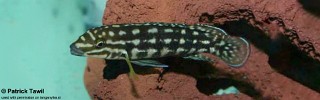
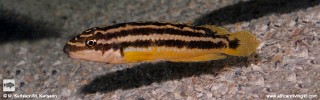
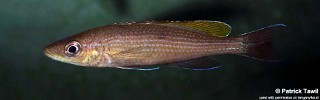



Photo gallery