Dark rocky habitats, especially vertical rock faces, overhangs and deep
caves. The species remains in constant close contact with the substrate,
often swimming head-down or upside-down with the belly facing the rock
surface.
Geographic distribution:
Restricted to the Tanzanian coast of Lake Tanganyika, over a stretch of
roughly 100 km between Cape Mpimbwe (Utinta) and Ninde, with the southernmost
records from Kisi Island. Occurs sympatrically with Neolamprologus furcifer
in parts of its range.
Typical adult size:
Up to about 13 cm total length, or up to approximately 16 cm when measured
to the tips of the caudal-fin streamers. Females are on average about 15%
smaller than males.
Sexual dimorphism:
No obvious differences in coloration or fin shape; males are on average
larger than females.
Recommended aquarium size:
At least 300 L.
Aquarium setup:
The aquarium should be arranged to mimic dark rocky habitats with vertical
walls, overhangs and deep caves, allowing the fish to display its natural
head-down swimming behavior. This can be achieved with large stones or
artificial 3D rock modules. Each individual strongly defends its territory,
so ample space is required. Best kept as a harem with one male and several
females. Suitable tankmates are species occupying other zones, such as
sand-dwelling cichlids.
Diet:
Carnivorous. Presumed to feed mainly on small crustaceans and other
invertebrates collected from cracks and crevices in the rocks, and
occasionally on fish eggs. The species moves extremely close to the
substrate, aided by its very large eyes.
Breeding:
Little is known from the wild. It is assumed to follow a haremic breeding
system similar to N. furcifer, with males visiting the territories
of females for spawning. In captivity, successful breeding has been
reported, with clutches producing up to about 30 fry. Fry disperse quickly
and establish individual territories at a very small size.
Aggression:
Aggression is mainly limited to territorial defense. Intruders are chased
away but usually not physically injured.
Special notes:
Characterized by a triangular head, extremely large eyes and precise
head-down locomotion along rock surfaces. Compared to the closely related
Neolamprologus furcifer, the swim bladder appears less sensitive to
pressure changes, and aquarium specimens do not usually suffer from buoyancy
disorders.
Distinction from N. furcifer:N. timidus has a scaled cheek (vs. naked in N. furcifer),
a longer head and pectoral fins, the first soft ray of the pelvic fin longer
than the second (vs. the opposite in N. furcifer), and lacks the
dark spot at the caudal-fin base present in adult N. furcifer.
Body markings usually include two narrow longitudinal stripes, whereas
N. furcifer shows broader, blotchy markings when present. The pelvic
fin of N. timidus appears pointed and triangular, while it is more
rounded in N. furcifer.
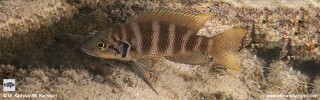
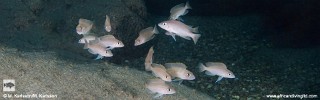
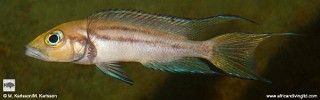
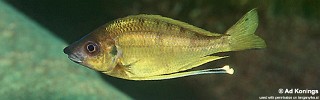
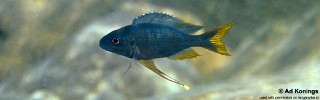
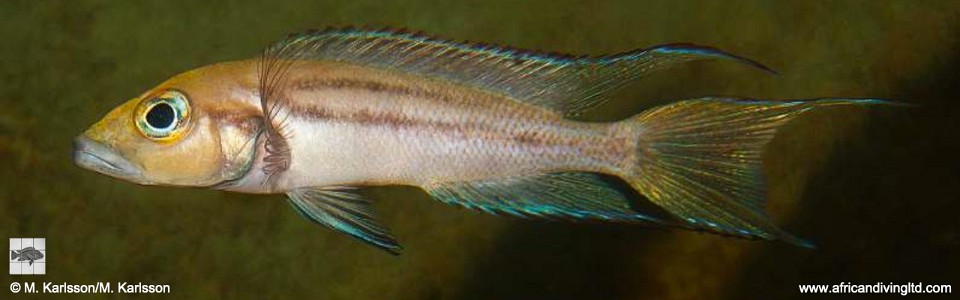



Distinction from N. furcifer: N. timidus has a scaled cheek (vs. naked in N. furcifer), a longer head and pectoral fins, the first soft ray of the pelvic fin longer than the second (vs. the opposite in N. furcifer), and lacks the dark spot at the caudal-fin base present in adult N. furcifer. Body markings usually include two narrow longitudinal stripes, whereas N. furcifer shows broader, blotchy markings when present. The pelvic fin of N. timidus appears pointed and triangular, while it is more rounded in N. furcifer.
Photo gallery