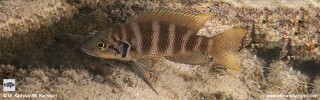
Rocky shores at depths between 2 and 15 m. The species often occurs
sympatrically with Altolamprologus compressiceps and
Altolamprologus calvus.
Geographic distribution:
Endemic to Lake Tanganyika with a lake-wide distribution. No geographic
variants are known.
Typical adult size:
Males may reach up to about 15 cm total length, while females remain
considerably smaller, usually up to around 9 cm.
Sexual dimorphism:
Males are significantly larger than females.
Recommended aquarium size:
Around 200 L for a pair.
Aquarium setup:
The aquarium should contain a large amount of rockwork arranged to form
caves and narrow crevices. For breeding, very narrow cave entrances
must be provided so that only the female can enter, while the male
remains outside. The bottom should be covered with fine sand.
A tank of at least 100 cm length and approximately 200 L is
required for a pair; keeping multiple individuals or combining this
species with other Tanganyika cichlids requires a larger aquarium.
Diet:
Carnivorous predator. Feeds mainly on juvenile cichlids, but will also
take smaller invertebrates. Compared with
A. compressiceps and A. calvus, it attacks prey from
a greater distance, often from around one meter. In aquaria, it
accepts various live and frozen foods such as krill, mysis and
cyclops.
Breeding:
Outside the breeding season, males are usually solitary and cruise the
rocky habitat in search of prey. During spawning, a weakly bonded
pair is formed. The female selects a narrow cave that only she can
enter; the male releases sperm from outside through the narrow
entrance to fertilize the eggs. The female guards the eggs inside
the cave, while the male patrols the area for a short time, usually
leaving before the fry become free-swimming after about 10 days.
Clutch size is typically around 200 eggs.
Aggression:
Males can be quite aggressive toward conspecifics. Toward other species
it is relatively peaceful and becomes territorial mainly during the
breeding period.
Special notes:
This species occurs throughout Lake Tanganyika and often shares its
habitat with A. calvus and A. compressiceps, yet no
geographic variants are known despite its wide distribution.
The taxonomic placement of this species has long been debated.
Some authors place it in Altolamprologus based on
morphological similarities, while others retain it in
Neolamprologus, which is the currently accepted placement by
CAS. It differs from A. calvus and
A. compressiceps mainly by its more elongated and elegant
body shape. A hybrid origin involving an
Altolamprologus and a Lamprologus ancestor has been
proposed, which may help explain the ongoing uncertainty regarding
its generic assignment.
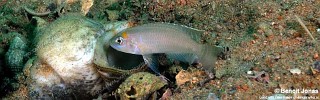
Tribe / Genus:
Lamprologini / Neolamprologus
Type locality:
Kinyamkolo, Lake Tanganyika.
Biotope:
Rocky shores at depths between 2 and 15 m. The species often occurs
sympatrically with Altolamprologus compressiceps and
Altolamprologus calvus.
Geographic distribution:
Endemic to Lake Tanganyika with a lake-wide distribution. No geographic
variants are known.
Typical adult size:
Males may reach up to about 15 cm total length, while females remain
considerably smaller, usually up to around 9 cm.
Sexual dimorphism:
Males are significantly larger than females.
Recommended aquarium size:
Around 200 L for a pair.
Aquarium setup:
The aquarium should contain a large amount of rockwork arranged to form
caves and narrow crevices. For breeding, very narrow cave entrances
must be provided so that only the female can enter, while the male
remains outside. The bottom should be covered with fine sand.
A tank of at least 100 cm length and approximately 200 L is
required for a pair; keeping multiple individuals or combining this
species with other Tanganyika cichlids requires a larger aquarium.
Diet:
Carnivorous predator. Feeds mainly on juvenile cichlids, but will also
take smaller invertebrates. Compared with
A. compressiceps and A. calvus, it attacks prey from
a greater distance, often from around one meter. In aquaria, it
accepts various live and frozen foods such as krill, mysis and
cyclops.
Breeding:
Outside the breeding season, males are usually solitary and cruise the
rocky habitat in search of prey. During spawning, a weakly bonded
pair is formed. The female selects a narrow cave that only she can
enter; the male releases sperm from outside through the narrow
entrance to fertilize the eggs. The female guards the eggs inside
the cave, while the male patrols the area for a short time, usually
leaving before the fry become free-swimming after about 10 days.
Clutch size is typically around 200 eggs.
Aggression:
Males can be quite aggressive toward conspecifics. Toward other species
it is relatively peaceful and becomes territorial mainly during the
breeding period.
Special notes:
This species occurs throughout Lake Tanganyika and often shares its
habitat with A. calvus and A. compressiceps, yet no
geographic variants are known despite its wide distribution.
The taxonomic placement of this species has long been debated.
Some authors place it in Altolamprologus based on
morphological similarities, while others retain it in
Neolamprologus, which is the currently accepted placement by
CAS. It differs from A. calvus and
A. compressiceps mainly by its more elongated and elegant
body shape. A hybrid origin involving an
Altolamprologus and a Lamprologus ancestor has been
proposed, which may help explain the ongoing uncertainty regarding
its generic assignment.
A tank of at least 100 cm length and approximately 200 L is required for a pair; keeping multiple individuals or combining this species with other Tanganyika cichlids requires a larger aquarium.
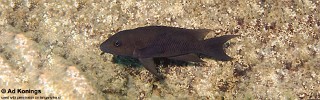
The taxonomic placement of this species has long been debated. Some authors place it in Altolamprologus based on morphological similarities, while others retain it in Neolamprologus, which is the currently accepted placement by CAS. It differs from A. calvus and A. compressiceps mainly by its more elongated and elegant body shape. A hybrid origin involving an Altolamprologus and a Lamprologus ancestor has been proposed, which may help explain the ongoing uncertainty regarding its generic assignment.
A tank of at least 100 cm length and approximately 200 L is required for a pair; keeping multiple individuals or combining this species with other Tanganyika cichlids requires a larger aquarium.
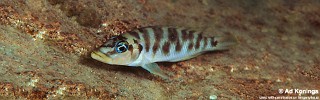
The taxonomic placement of this species has long been debated. Some authors place it in Altolamprologus based on morphological similarities, while others retain it in Neolamprologus, which is the currently accepted placement by CAS. It differs from A. calvus and A. compressiceps mainly by its more elongated and elegant body shape. A hybrid origin involving an Altolamprologus and a Lamprologus ancestor has been proposed, which may help explain the ongoing uncertainty regarding its generic assignment.
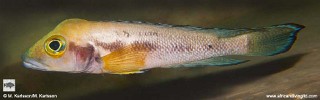
Photo gallery