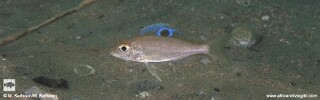
Open water of deep rocky shores. This species inhabits depths generally
below 20 meters and occurs in large schools together with
Cyprichromis leptosoma, C. pavo and
C. coloratus.
Geographic distribution:
Southern Kipili Islands area, Lake Tanganyika (Zambia).
Typical adult size:
Males reach up to about 10 cm total length; females remain 1–2 cm smaller.
Sexual dimorphism:
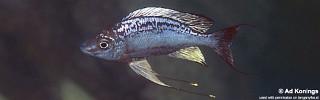
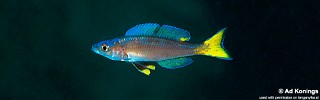
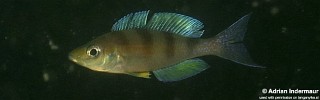
Males are more colourful than females. Females are beige to light brown.
Recommended aquarium size:
Minimum 300 L
Aquarium setup:
Provide an aquarium with plenty of open swimming space and only a few
rocks for orientation and shelter. Substrate choice is not important,
as the species neither feeds nor spawns on the bottom.
The species should be kept in groups of at least 10 individuals.
As it naturally inhabits deeper water (20 m and below), strong lighting
should be avoided; dimmer lighting is strongly recommended.
Diet:
Carnivorous planktivore. Feeds mainly on zooplankton and small
invertebrates in the water column.
Breeding:
Maternal mouthbrooder. Breeding behavior is similar to that of
Cyprichromis pavo. Unlike most Cyprichromis species, males do not
maintain three-dimensional territories in open water. Instead, the male
defends a territory facing a vertical rock surface and attempts to lure
females to this site for spawning.
Spawning takes place in front of the vertical rock. Clutch size usually
ranges from 6 to 15 eggs, but after an incubation period of about four
weeks, females rarely release more than 8 fry.
Aggression:
Relatively peaceful and suitable for keeping with various sand-dwelling
Tanganyikan cichlids.
Special notes:
This species has previously been known under the trade names
“Zebra Leptosoma” and “Wimple Leptosoma”.
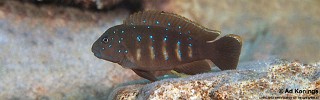
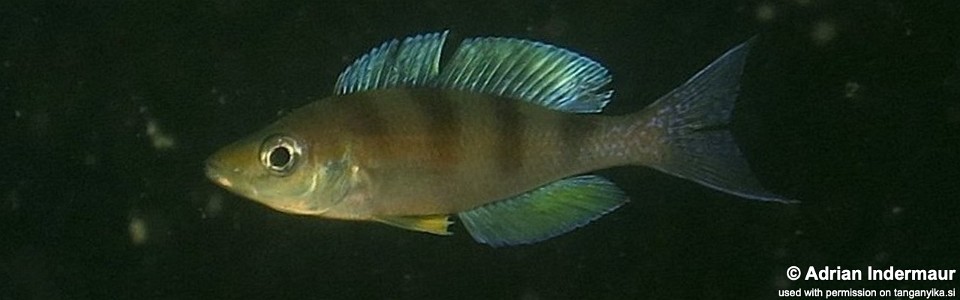
Males are yellowish in ground colour and show distinct transverse bars
on the body, which gave rise to the “zebra” name. These bars are usually
visible and number four.
Unlike most Cyprichromis species, males of C. sp. 'Kipili Zebra'
are not polymorphic; males within the same population
share the same colour pattern.
Until recently, Cyprichromis zonatus was thought to inhabit only
the southern part of the lake, from the western Chituta Bay to Cape Kaku.
African Diving Ltd later discovered two zebra-patterned populations:
C. sp. 'Mpimbwe Zebra' at Frontosa Reef near Cape Mpimbwe
(45–60 m depth), and C. sp. 'Kipili Zebra' at Mvuna Island in the
Kipili archipelago.
These populations are very similar to C. zonatus, but differ in
coloration and bar pattern. In C. sp. 'Mpimbwe Zebra' and
C. sp. 'Kipili Zebra', the transverse bars are always four and
consistently visible, whereas in C. zonatus there are three or
four bars, which may sometimes be indistinct.
Ad Konings regards these forms as geographical variants of
C. zonatus. African Diving Ltd, however, considers the differences
potentially significant and recommends treating
C. sp. 'Mpimbwe Zebra' and C. sp. 'Kipili Zebra' as
potentially distinct species until detailed taxonomic studies are
conducted.



The species should be kept in groups of at least 10 individuals. As it naturally inhabits deeper water (20 m and below), strong lighting should be avoided; dimmer lighting is strongly recommended.
Spawning takes place in front of the vertical rock. Clutch size usually ranges from 6 to 15 eggs, but after an incubation period of about four weeks, females rarely release more than 8 fry.
Unlike most Cyprichromis species, males of C. sp. 'Kipili Zebra' are not polymorphic; males within the same population share the same colour pattern.
Until recently, Cyprichromis zonatus was thought to inhabit only the southern part of the lake, from the western Chituta Bay to Cape Kaku. African Diving Ltd later discovered two zebra-patterned populations: C. sp. 'Mpimbwe Zebra' at Frontosa Reef near Cape Mpimbwe (45–60 m depth), and C. sp. 'Kipili Zebra' at Mvuna Island in the Kipili archipelago.
These populations are very similar to C. zonatus, but differ in coloration and bar pattern. In C. sp. 'Mpimbwe Zebra' and C. sp. 'Kipili Zebra', the transverse bars are always four and consistently visible, whereas in C. zonatus there are three or four bars, which may sometimes be indistinct.
Ad Konings regards these forms as geographical variants of C. zonatus. African Diving Ltd, however, considers the differences potentially significant and recommends treating C. sp. 'Mpimbwe Zebra' and C. sp. 'Kipili Zebra' as potentially distinct species until detailed taxonomic studies are conducted.
Photo gallery