Albertville [Mtoa], Lake Tanganyika, Congo [Democratic Republic of Congo].
Biotope:
Typically inhabits sandy or muddy bottoms where empty snail shells are scarce
and scattered. Usually found at depths greater than 5 m and recorded down to
40 m. Only rarely occurs on dense shell beds; at Karilani Island such shell beds
are thickly encrusted with calcium deposits and inhabited almost exclusively by
this species and small shell-dwelling Telmatochromis.
Geographic distribution:
Occurs throughout Lake Tanganyika.
Typical adult size:
Males reach up to 5 cm total length, while females rarely exceed 4 cm.
The species remains small both in the wild and in aquarium conditions.
Sexual dimorphism:
Sexes are difficult to distinguish when immature. Males are consistently
slightly larger at all stages of growth. Adult females of some populations
develop a light yellow to golden yellow belly, making them easy to distinguish
from males.
Recommended aquarium size:
60 liters for a pair.
Aquarium setup:
A sandy substrate with a relatively thick layer of fine sand is essential,
as the fish actively excavate the substrate. One empty snail shell per pair
should be provided as shelter and breeding site. Neothauma shells are preferred,
but shells of suitable local snails are also accepted. Pairs should be kept with
sufficient spacing between shells. Larger predatory tank mates must be avoided.
Diet:
Carnivorous plankton feeder. In the wild, pairs hover 10–20 cm above their
shell and feed on passing zooplankton. In captivity they accept live and frozen
foods such as Cyclops, Artemia, Daphnia, and other small invertebrates.
Breeding:
Serially monogamous shell-brooder. Male and female usually share a single
snail shell, which is unique among Tanganyikan shell-dwellers. Spawning takes
place inside the shell. The male often remains with the female until the fry
become free-swimming, after which he may leave. Brood size is typically
15–25 fry. Fry leave the parental shell one to two weeks after becoming mobile
and search for shells of their own.
Aggression:
Generally peaceful, but strongly defends the immediate area around its
shell against intruders.
Special notes:
This is the only known Tanganyikan shell-dwelling cichlid in which both male
and female routinely occupy the same shell. Unlike most shell-brooders that live
in harems, this species lives in pairs, allowing it to inhabit areas with very
low shell density where other shell-dwellers are absent. When threatened, the
smaller female enters the shell first, followed by the male.

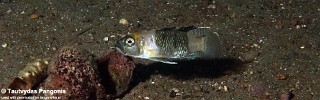
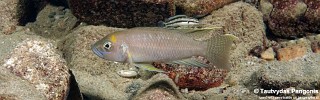
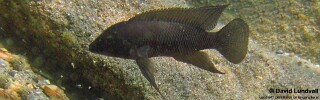



Photo gallery