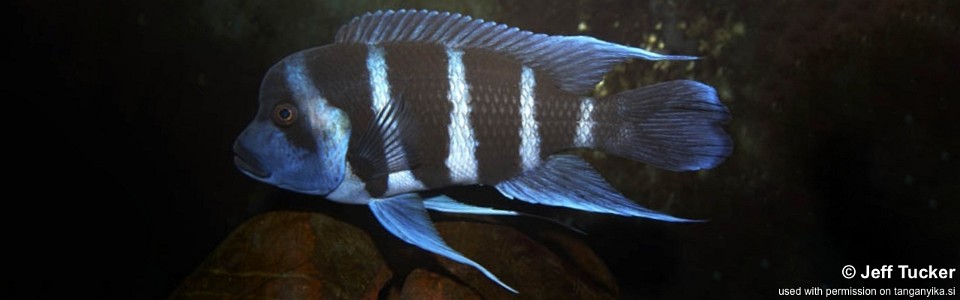
Kasenga Point, near Mpulungu, Lake Tanganyika (Zambia)
Biotope:
Deep rocky habitat, usually at depths of 20 m or more. Juveniles may occur at
shallower depths depending on locality and habitat structure. Lives in social
groups consisting of a dominant male, several females, and a few subordinate males.
Geographic distribution:
Southern part of Lake Tanganyika. In DR Congo south of Kalemie, and in Tanzania
south of Isonga along the Isonga–Ikola coast. Zambian populations along the entire
shoreline are generally attributed to this species.
Typical adult size:
Males commonly reach 35 cm TL or more. In aquaria they may grow even larger.
Sexual dimorphism:
Males are larger than females and develop a more pronounced nuchal hump.
Sexual differences become increasingly obvious with age.
Recommended aquarium size:
At least 1000 L; larger aquaria strongly recommended.
Aquarium setup:
Best kept in groups, preferably in a species-only aquarium or together with
other large Tanganyikan cichlids such as Lepidiolamprologus,
Gnathochromis, or larger Neolamprologus. Smaller cichlids
(e.g. Julidochromis, Cyprichromis) are unsuitable as they may
be preyed upon. The aquarium should replicate the natural habitat with subdued
lighting, extensive rockwork, and open swimming space.
Diet:
Predatory. Juveniles feed mainly on soft-bodied crustaceans, while adults are
primarily piscivorous. Stomach content analyses of wild specimens reveal
remains of fish, mussels, insect larvae, shrimps, and snails. In captivity,
this species readily consumes tankmates approaching half its own size.
Breeding:
Maternal mouthbrooder with a unique spawning behaviour shared only with
Trematochromis benthicola. Males do not dig nests nor defend strict
territories. Spawning occurs within the group at loosely defended sites.
The female lays eggs while moving backwards over the spawning site and
collects them without the typical turning behaviour seen in other mouthbrooders.
Eggs are brooded for approximately five weeks before the fry are released.
Aggression:
Generally moderate within the group structure, but adults are highly dominant
and strongly predatory due to their size.
Special notes:
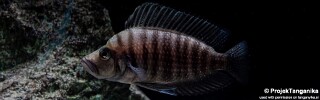
Cyphotilapia gibberosa was described by Takahashi & Nakaya (2003)
from the southernmost part of Lake Tanganyika and is typically characterised
by five body bars plus one head bar, as well as three scale rows between the
upper and lower lateral line.
The taxonomy of Cyphotilapia is debated. Some authors, notably
Ad Konings, recognise only a single species (C. frontosa) and
regard C. gibberosa as a junior synonym. Other authors consider
C. gibberosa a valid species, supported by consistent morphological
and geographic patterns.
Central lake populations show overlapping characteristics of
C. frontosa and C. gibberosa. African Diving suggests these
populations may be of hybrid origin following historical lake-level
fluctuations that brought previously isolated lineages into secondary contact.
In the aquarium hobby, the best-known form of this species is the so-called
“Blue Zaire” variant from southern DR Congo, noted for its deep, intense blue
coloration. Similar but slightly paler variants occur in Tanzania (e.g.
Kansombo and Cape Mpimbwe), while Zambian populations often show intermediate
coloration.





The taxonomy of Cyphotilapia is debated. Some authors, notably Ad Konings, recognise only a single species (C. frontosa) and regard C. gibberosa as a junior synonym. Other authors consider C. gibberosa a valid species, supported by consistent morphological and geographic patterns.
Central lake populations show overlapping characteristics of C. frontosa and C. gibberosa. African Diving suggests these populations may be of hybrid origin following historical lake-level fluctuations that brought previously isolated lineages into secondary contact.
In the aquarium hobby, the best-known form of this species is the so-called “Blue Zaire” variant from southern DR Congo, noted for its deep, intense blue coloration. Similar but slightly paler variants occur in Tanzania (e.g. Kansombo and Cape Mpimbwe), while Zambian populations often show intermediate coloration.
Photo gallery