Near Karema, Lake Tanganyika, Tanzania (100–125 m depth).
Biotope:
Deep to very deep offshore habitats above sandy or muddy bottoms.
The species is most abundant at depths of approximately 160–200 m and
is extremely rare above 50 m. Unlike Benthochromis horii,
it has not been reliably observed in relatively shallow rocky breeding habitats.
Geographic distribution:
Lake Tanganyika. Reported from various regions around the lake,
with geographical variation noted between northern and southern populations.
Typical adult size:
Males up to approximately 25 cm total length; females slightly smaller.
Sexual dimorphism:
Pronounced sexual dichromatism.
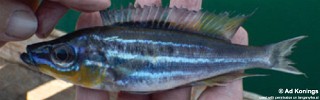
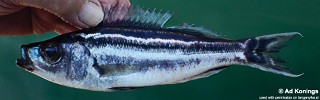
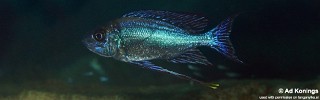
Females are silvery-grey and lack horizontal stripes.
Breeding males are mauve-grey to bluish with two bright electric-blue
horizontal stripes (lacking the lower stripe that crosses the pectoral fin in
B. horii), a yellow throat, and long filamentous extensions of the caudal
and pelvic fins. Non-breeding males may lose most coloration and appear silvery.
Recommended aquarium size:
Not established with certainty; very large aquaria (≥500 L) are considered
the minimum for long-term maintenance of adult specimens.
Aquarium setup:
Large aquarium with open swimming space and subdued lighting.
Fine sand substrate; spawning sites may consist of flat stones,
vertical rock faces, or shallow sand depressions.
Extremely sensitive to disturbance and prone to panic reactions;
calm surroundings and very peaceful tankmates are essential.
Diet:
Zooplanktivorous. Feeds primarily on copepods and other zooplankton.
In aquaria, accepts a wide range of foods including planktonic frozen foods,
small invertebrates, and other suitable animal-based diets.
Breeding:
Maternal mouthbrooder.
Males defend territories and display intensely over rock surfaces
or sand depressions. Clutch size is very small (typically 5–15 eggs),
with tiny eggs (~2 mm).
Females brood for an extended period, often exceeding two months,
and release only a few relatively large fry.
Aggression:
Intraspecific aggression is high between males during breeding.
Interspecific aggression is generally low, but fin-nipping species
must be avoided due to the males’ long filamentous fins.
Special notes:
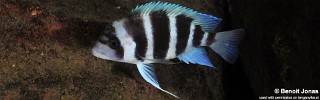
The name Benthochromis tricoti has historically been widely misapplied
in the aquarium hobby to specimens of B. horii.
Most fish traded as “B. tricoti” are in fact B. horii.
True B. tricoti appears to be a deep-water species rarely encountered
alive, which explains its scarcity in aquaria and the long-standing taxonomic
confusion within the genus.
Males are best distinguished from congeners by having exactly two horizontal
blue stripes, while B. horii has three and
B. melanoides has none.




Females are silvery-grey and lack horizontal stripes.
Breeding males are mauve-grey to bluish with two bright electric-blue horizontal stripes (lacking the lower stripe that crosses the pectoral fin in B. horii), a yellow throat, and long filamentous extensions of the caudal and pelvic fins. Non-breeding males may lose most coloration and appear silvery.
Fine sand substrate; spawning sites may consist of flat stones, vertical rock faces, or shallow sand depressions.
Extremely sensitive to disturbance and prone to panic reactions; calm surroundings and very peaceful tankmates are essential.
In aquaria, accepts a wide range of foods including planktonic frozen foods, small invertebrates, and other suitable animal-based diets.
Males defend territories and display intensely over rock surfaces or sand depressions. Clutch size is very small (typically 5–15 eggs), with tiny eggs (~2 mm).
Females brood for an extended period, often exceeding two months, and release only a few relatively large fry.
True B. tricoti appears to be a deep-water species rarely encountered alive, which explains its scarcity in aquaria and the long-standing taxonomic confusion within the genus.
Males are best distinguished from congeners by having exactly two horizontal blue stripes, while B. horii has three and B. melanoides has none.
Photo gallery