Lufuku River at Pala, Democratic Republic of Congo.
Biotope:
Marginal riverine habitats and river deltas with dense vegetation.
Prefers areas rich in reeds, dead wood, and aquatic plants that provide abundant cover.
Absent from open water in both rivers and the lake itself.
Geographic distribution:
Lake Tanganyika basin. Originally described from northern tributaries in the Democratic Republic of Congo and Burundi
(including the Lufuku and Ruzizi rivers), and later recorded from southern tributaries such as the Kalambo and Lufubu rivers.
Current evidence suggests a distribution encompassing tributary systems around much of the lake.
Typical adult size:
Males typically reach 12–14 cm total length.
Females remain much smaller, usually not exceeding about 8 cm.
Sexual dimorphism:
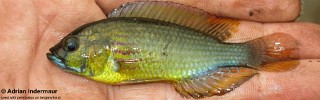
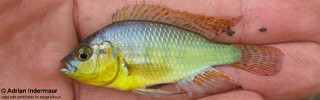
Typical haplochromine dimorphism. Males grow larger and display much stronger coloration.
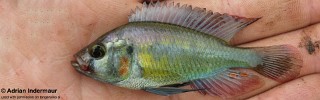
Females are silvery grey with subdued body markings and very faint anal-fin ocelli.
Recommended aquarium size:
250 L
Aquarium setup:
A strongly structured or densely planted aquarium is recommended to provide cover for females and subordinate individuals.
Use sand or fine gravel substrate and include roots, dead wood, and robust aquatic plants.
Male territories are relatively small, but visual barriers are important to reduce stress.
Diet:
Omnivorous with a preference toward animal matter.
Likely feeds on insect larvae, crustaceans, and mollusks in nature.
In aquaria, it readily accepts a wide range of common dry, frozen, and live foods.
Breeding:
Maternal mouthbrooder with typical haplochromine breeding behaviour.
A territorial male excavates a small depression and courts females with lateral displays and quivering.
Eggs are collected immediately by the female and fertilized in the mouth as she attempts to take the male’s anal ocelli.
The female broods the eggs and fry alone and releases them after approximately 20 days, during which time she does not feed.
Aggression:
Males can be aggressive, especially toward females outside the breeding period.
In small groups, females may be treated roughly when not gravid.
Adequate space and cover help to reduce aggression.
Special notes:
Closely related to the Lake Victoria cichlid species flock and considered phylogenetically informative for understanding
colonization and evolution patterns in East African cichlids.
Its distribution pattern closely mirrors that of Astatotilapia burtoni, suggesting repeated and widespread
colonization of tributary habitats around Lake Tanganyika.



Use sand or fine gravel substrate and include roots, dead wood, and robust aquatic plants. Male territories are relatively small, but visual barriers are important to reduce stress.
Eggs are collected immediately by the female and fertilized in the mouth as she attempts to take the male’s anal ocelli. The female broods the eggs and fry alone and releases them after approximately 20 days, during which time she does not feed.
Its distribution pattern closely mirrors that of Astatotilapia burtoni, suggesting repeated and widespread colonization of tributary habitats around Lake Tanganyika.
Photo gallery