Deep rocky habitat. Usually found at depths greater than 25 m,
often inhabiting rock crevices and caves. The same areas are commonly shared
with Paracyprichromis brieni. Non-territorial males feed in open water
but always remain close to rocky structures.
Geographic distribution:
Endemic to Lake Tanganyika with populations occurring all around
the lake. According to Ad Konings, all nigripinnis-like populations belong to
Paracyprichromis nigripinnis, while other authors recognize several
distinct species within this complex.
A form from Tembwe (Deux) with shorter caudal fin lobes has been treated as a
separate species by Heinz H. Büscher under the provisional name
Paracyprichromis sp. 'Tembwe'.
Populations from Mahale Mountains National Park, also occurring at Kekese and
Segunga, show permanently black vertical bars, short caudal fin lobes and a
preference for more open water; these are regarded here as a distinct species,
provisionally named Paracyprichromis sp. 'Ammelrooyi'.
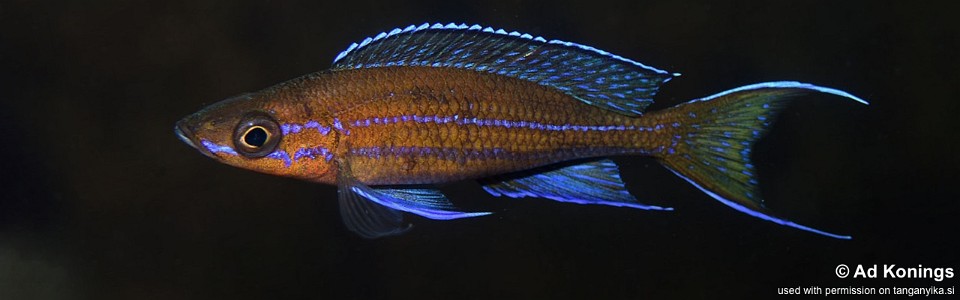
Typical P. nigripinnis from the southern part of the lake usually show
very long caudal fin extensions, while nigripinnis-like populations north of
Cape Mpimbwe generally have short caudal fin lobes and are here treated as
P. cf. nigripinnis.
Typical adult size:
Up to about 10 cm total length.
Sexual dimorphism:
Males and females are similar in general appearance, but males
typically develop longer and more pronounced fin extensions, especially of
the caudal fin, compared to females.
Recommended aquarium size:
Minimum 250 L.
Aquarium setup:
Best kept in groups of at least 10 individuals, reflecting their
natural schooling behaviour. Provide ample open swimming space combined with
vertically placed rocks forming crevices and caves used as shelter and
spawning sites. Lighting should be subdued. Avoid housing with aggressive
species; suitable tankmates include peaceful bottom dwellers such as
Xenotilapia.
Diet:
Carnivorous. In nature feeds primarily on zooplankton and small
crustaceans captured in the water column.
Breeding:
Maternal mouthbrooder. Males maintain territories under overhanging
rocks or within caves. Spawning takes place head-down against a rock surface;
the female releases one egg at a time, while the male releases sperm
immediately before the egg is taken into the female’s mouth. The entire act
occurs extremely rapidly. The female broods the eggs and larvae for about
three weeks before releasing them. Clutch size is usually between 8 and 15
eggs, with a maximum of about 25.
Aggression:
Relatively peaceful and should not be kept together with aggressive
cichlid species.
Special notes:
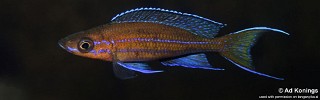
Paracyprichromis nigripinnis often occurs sympatrically with
P. brieni, from which it differs by having larger eyes and a deeper,
more compact body shape. Originally both species were placed in the genus
Cyprichromis, but were transferred to Paracyprichromis by Poll
in 1986. mtDNA analyses have confirmed that P. nigripinnis and
P. brieni are closely related to each other but not to species of
Cyprichromis.
A key biological difference from Cyprichromis species is the mode of
fertilisation: in Paracyprichromis, eggs are fertilised outside the
female’s mouth before being collected for incubation.



A form from Tembwe (Deux) with shorter caudal fin lobes has been treated as a separate species by Heinz H. Büscher under the provisional name Paracyprichromis sp. 'Tembwe'.
Populations from Mahale Mountains National Park, also occurring at Kekese and Segunga, show permanently black vertical bars, short caudal fin lobes and a preference for more open water; these are regarded here as a distinct species, provisionally named Paracyprichromis sp. 'Ammelrooyi'.
Typical P. nigripinnis from the southern part of the lake usually show very long caudal fin extensions, while nigripinnis-like populations north of Cape Mpimbwe generally have short caudal fin lobes and are here treated as P. cf. nigripinnis.
A key biological difference from Cyprichromis species is the mode of fertilisation: in Paracyprichromis, eggs are fertilised outside the female’s mouth before being collected for incubation.
Photo gallery