Upper part of the rocky littoral zone close to the shoreline.
Strictly associated with very shallow, wave-exposed rocky habitats and
not found outside these turbulent nearshore zones.
Adapted to strong wave action; body shape and long dorsal fin allow the
fish to maintain position in rough water.
Geographic distribution:
Spathodus marlieri has been reported from areas north of
Kigoma, from Burundi, and from Uvira in the Democratic Republic of the Congo,
which is the type locality of the species.
Due to its extremely shy behavior, it is possible that the species has been
overlooked by divers and collectors at additional locations, and its actual
distribution may be wider than currently documented.
Typical adult size:
The largest goby cichlid species.
In Lake Tanganyika it reaches up to about 10 cm total length; in aquaria it
may grow slightly larger.
Females are considerably smaller, usually up to about 6 cm.
Sexual dimorphism:
Sexual dimorphism is mainly expressed in size.
Males grow significantly larger than females; females remain much smaller
and more slender.
Recommended aquarium size:
At least 300 L for a well-established pair.
Aquarium setup:
Very aggressive within the species, except for stable pairs.
Even established pairs may engage in frequent fights, especially after
loss of eggs or fry; therefore a minimum of 300 L is required even for
a single pair, and 500 L or more for keeping multiple individuals.
Provide abundant rockwork with many hiding places and retreats.
Fine sand substrate is recommended.
Strong water flow is essential to replicate the natural wave-swept habitat.
Suitable tank mates include other goby cichlids of different species,
small lamprologines (Julidochromis, Neolamprologus),
and open-water species such as Cyprichromis and
Benthochromis.
Diet:
Omnivorous aufwuchs feeder.
Feeds on algae and small invertebrates living within the aufwuchs.
Mouth width and feeding strategy are intermediate between the more
algae-specialized Eretmodus and the more invertebrate-oriented
Tanganicodus.
Breeding:
Maternal mouthbrooder.
Unlike most other goby cichlids, brood care is almost exclusively carried
out by the female; the male takes over brooding only in exceptional cases.
The female broods the eggs and fry for approximately three weeks.
Aggression:
Extremely aggressive within the species.
Aggression toward other species is relatively low, but keeping more than
a single pair requires very large aquaria exceeding 500 L.
Special notes:
Among all goby cichlids, this species is the least abundant in Lake
Tanganyika and is restricted to the upper third of the lake.
Unlike other goby cichlids, it does not require constant contact with the
substrate and is often observed swimming away from the rocks.
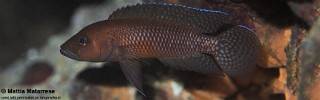
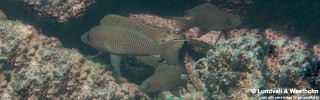
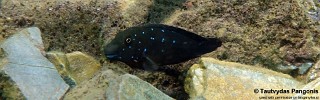
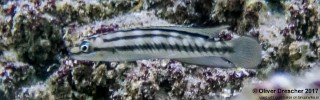
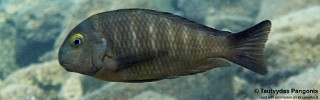
It differs from other goby cichlids by its brown to beige body coloration,
with only a few blue spots restricted mainly to the head and without
distinct vertical body bars.



Strictly associated with very shallow, wave-exposed rocky habitats and not found outside these turbulent nearshore zones.
Adapted to strong wave action; body shape and long dorsal fin allow the fish to maintain position in rough water.
Due to its extremely shy behavior, it is possible that the species has been overlooked by divers and collectors at additional locations, and its actual distribution may be wider than currently documented.
In Lake Tanganyika it reaches up to about 10 cm total length; in aquaria it may grow slightly larger.
Females are considerably smaller, usually up to about 6 cm.
Males grow significantly larger than females; females remain much smaller and more slender.
Even established pairs may engage in frequent fights, especially after loss of eggs or fry; therefore a minimum of 300 L is required even for a single pair, and 500 L or more for keeping multiple individuals.
Provide abundant rockwork with many hiding places and retreats.
Fine sand substrate is recommended.
Strong water flow is essential to replicate the natural wave-swept habitat.
Suitable tank mates include other goby cichlids of different species, small lamprologines (Julidochromis, Neolamprologus), and open-water species such as Cyprichromis and Benthochromis.
Feeds on algae and small invertebrates living within the aufwuchs.
Mouth width and feeding strategy are intermediate between the more algae-specialized Eretmodus and the more invertebrate-oriented Tanganicodus.
Unlike most other goby cichlids, brood care is almost exclusively carried out by the female; the male takes over brooding only in exceptional cases.
The female broods the eggs and fry for approximately three weeks.
Aggression toward other species is relatively low, but keeping more than a single pair requires very large aquaria exceeding 500 L.
Unlike other goby cichlids, it does not require constant contact with the substrate and is often observed swimming away from the rocks.
It differs from other goby cichlids by its brown to beige body coloration, with only a few blue spots restricted mainly to the head and without distinct vertical body bars.
Photo gallery