Sandy habitats. Occurs at depths between 3 and 25 m.
Geographic distribution:
Southern part of Lake Tanganyika. According to Verne (2001), found from
Moliro at the border of the Democratic Republic of Congo and Zambia to
Utinta Bay, just north of Cape Mpimbwe in Tanzania.
Typical adult size:
Up to about 14 cm (males), females usually smaller.
Recommended aquarium size:
Minimum 150 L; larger aquaria (400 L or more) recommended for breeding groups.
Aquarium setup:
Fine sand substrate is essential, as this species forages and spawns on sand.
Rocks are not required, but a few may be added as territorial boundaries.
Diet:
Omnivorous. Feeds mainly on insect larvae and small crustaceans filtered from
the sand.
Breeding:
Maternal mouthbrooder. A lek-forming species: males construct saucer-shaped
nests in the sand and attract females for spawning. Egg clutches usually
consist of 15–40 eggs, which are incubated for about three weeks.
Aggression:
Relatively peaceful. Multiple males can be kept together, though males may
become territorial and quarrelsome during breeding.
Special notes:
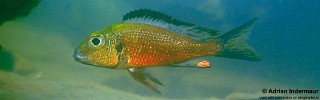
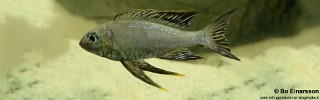
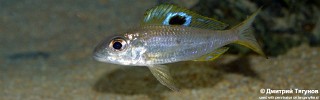
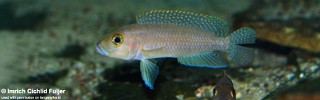
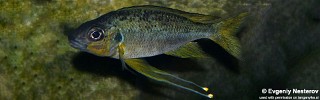
Ectodus descampsii is distinguished from the similar
Ectodus sp. 'north' by a higher dorsal fin with the black blotch
positioned further back. Zambian males often show a pronounced yellowish hue.
There has been historical confusion regarding the type locality; although
Poll (1956) listed Moliro, it is now considered likely that true
E. descampsii originates from the southern part of the lake, while
northern populations may represent an undescribed species.
Like other ectodines, this species has the remarkable habit of burying itself
in the sand when threatened. During water changes, individuals have been
observed swimming through suspended sand particles.



There has been historical confusion regarding the type locality; although Poll (1956) listed Moliro, it is now considered likely that true E. descampsii originates from the southern part of the lake, while northern populations may represent an undescribed species.
Like other ectodines, this species has the remarkable habit of burying itself in the sand when threatened. During water changes, individuals have been observed swimming through suspended sand particles.
Photo gallery