Neolamprologus sp. 'caudopunctatus kipili' Mvuna Island
Tribe / Genus:
Lamprologini / Lamprologus
Biotope:
Inhabits the intermediate zone, occurring both in shallow waters and at greater
depths exceeding 25 m. Typically found very close to the substrate, in areas
between sand and rocks.
Geographic distribution:
Restricted to the southern Tanzanian coast of Lake Tanganyika. Confirmed
distribution extends for about 150 km between Karema and the Izinga area,
including Izinga Island.
Typical adult size:
Around 6 cm total length, with a reported maximum of approximately 7 cm.
Sexual dimorphism:
Males may be slightly larger than females; otherwise there are no clear visual
differences between the sexes.
Recommended aquarium size:
100 L
Aquarium setup:
Provide fine sand as substrate with several rocks arranged to form individual
caves. Snail shells may be added, as they are sometimes used as an alternative
spawning site in aquaria. Suitable for community aquaria with other Tanganyika
cichlids; aggression toward tankmates is usually limited to periods of brood
defense.
Diet:
Carnivorous; feeds on various invertebrates collected from the substrate and open
water, and also on zooplankton when feeding above the bottom. In aquaria it
accepts a variety of live and frozen foods such as mysis, krill, and Artemia.
Breeding:
A monogamous species that breeds in caves, usually excavated beneath rocks.
Snail shells may occasionally be used for spawning in aquaria, but this is rare
in the wild due to the absence of shells in its natural habitat. Females lay
approximately 75–150 eggs. Fry become free-swimming about one week after
spawning and immediately begin feeding on plankton. In the lake, both parents
guard the brood for around 40 days, until the juveniles reach about 2 cm, after
which they are abandoned. Multi-generational family groups have not been
observed in the wild, though aquarium observations indicate that parents may
tolerate previous broods, forming small colonies. Genetic analyses revealed that
up to 60% of juveniles in a brood may originate from other spawns, likely due to
parents expelling some offspring when territory safety declines.
Aggression:
Relatively peaceful, but can become noticeably aggressive during spawning and
while guarding fry.
Special notes:
Very similar to N. leloupi and N. caudopunctatus. It differs from
N. leloupi by lacking the black marginal band on the caudal fin. Separation
from N. caudopunctatus is more difficult; N. sp. “caudopunctatus
kipili” has a slightly lower body, longer head, and larger eyes. P. Tawil
considers these differences insufficient for species status and treats it as a
Tanzanian variant of N. caudopunctatus, whereas Ad Konings also noted
behavioural differences, particularly lower abundance and smaller group sizes.
Ecologically, unlike N. caudopunctatus and N. leloupi, which often
form large schools feeding several metres above the bottom, this taxon is usually
found in pairs close to the substrate, feeding on zoobenthos. Despite sometimes
being referred to as a shell-dweller, it is not a typical shell-brooding species
and naturally spawns in caves.
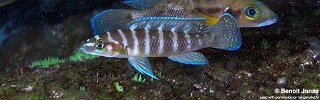
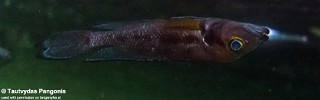
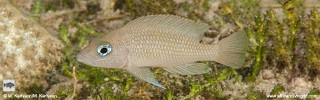
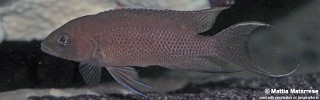
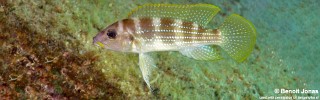



Photo gallery