Occurs throughout almost the entire Lake Tanganyika, except in areas south of the Kapampa locality
in the Democratic Republic of the Congo and further south to the Chimba area in Zambia, where it is replaced by
Petrochromis trewavasae.
Typical adult size:
Males typically reach about 20 cm and may grow to around 25 cm in aquaria; females remain about
20% smaller.
Sexual dimorphism:
Females are approximately 20% smaller than males.
Recommended aquarium size:
Minimum 500 L, with 800 L preferable (especially for long-term maintenance and larger groups).
Aquarium setup:
Use extensive rockwork arranged into several separated rock piles to form distinct territories,
while still leaving broad open areas for swimming.
Provide a sandy substrate. Strong filtration is important due to high food intake and the resulting waste load.
Diet:
Herbivorous grazer that scrapes algae from rocks. In aquaria, provide a primarily vegetable-based
diet, especially spirulina-rich flakes/pellets; high-protein foods should be offered only sparingly.
Breeding:
Maternal mouthbrooder.
The male attracts the female to his territory; the female lays eggs and immediately collects them into her
mouth. She then attempts to pick up the male’s “egg spots”, during which the male releases sperm that is taken
into the mouth, resulting in fertilization inside the female’s mouth.
Brood size is commonly around 15 in the wild and often around 30 in aquaria; after roughly 30 days the female
releases well-developed fry. It is noted that the female may continue feeding while brooding.
Aggression:
Highly aggressive, primarily towards conspecifics (both males and females). Keeping them in large
groups (about 12–15+ individuals, potentially with multiple males) helps distribute aggression and reduces
relentless pressure on females; small harems are not recommended.
Toward other species they are generally less focused, but males will defend territories. They can be intolerant
toward other Petrochromis, especially Petrochromis trewavasae.
Special notes:
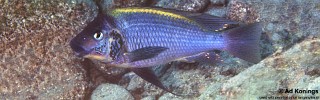
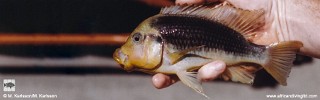
Among the larger Petrochromis; the species name refers to the pale “saddle” on the dorsal region
(ephippium = saddle). The saddle color may vary from white to yellow around the lake.
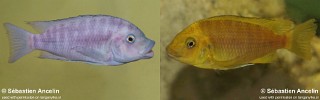
The well-known “Moshi Yellow” trade form is regarded as a color variant of Petrochromis ephippium rather than a
separate species; both yellow and brownish morphs can occur together at the same locality (e.g. Mabilibili Bay) and
may intergrade.
Tropheus are not considered ideal tankmates despite similar feeding, as Petrochromis are noted for very strong
appetite; combined feeding may predispose Tropheus to bloat, while Petrochromis are described as more resistant
in comparison.





Provide a sandy substrate. Strong filtration is important due to high food intake and the resulting waste load.
The male attracts the female to his territory; the female lays eggs and immediately collects them into her mouth. She then attempts to pick up the male’s “egg spots”, during which the male releases sperm that is taken into the mouth, resulting in fertilization inside the female’s mouth.
Brood size is commonly around 15 in the wild and often around 30 in aquaria; after roughly 30 days the female releases well-developed fry. It is noted that the female may continue feeding while brooding.
Toward other species they are generally less focused, but males will defend territories. They can be intolerant toward other Petrochromis, especially Petrochromis trewavasae.
The well-known “Moshi Yellow” trade form is regarded as a color variant of Petrochromis ephippium rather than a separate species; both yellow and brownish morphs can occur together at the same locality (e.g. Mabilibili Bay) and may intergrade.
Tropheus are not considered ideal tankmates despite similar feeding, as Petrochromis are noted for very strong appetite; combined feeding may predispose Tropheus to bloat, while Petrochromis are described as more resistant in comparison.
Photo gallery