Moliro, Lake Tanganyika, Democratic Republic of Congo
Biotope:
Shallow rocky habitats, typically at depths up to about 5 m.
Geographic distribution:
Found between Cape Kachese (Zambia) and Kapampa (Democratic Republic of the Congo).
At Kapampa it occurs sympatrically with Petrochromis ephippium. Petrochromis ephippium
is otherwise found throughout almost the entire lake, except in the area occupied by
P. trewavasae.
Typical adult size:
Males reach around 20 cm total length, occasionally up to about 22 cm in aquaria.
Females are approximately 20% smaller.
Sexual dimorphism:
Males and females are very similar in coloration. Dominant males may lose the
characteristic white spotting, while females and subordinate individuals usually
retain it.
Recommended aquarium size:
A minimum of 500 liters is required, with 800 liters being recommended.
Aquarium setup:
The aquarium should contain abundant rockwork arranged into several separated
territories using larger rock piles, while still providing open swimming areas.
A sandy substrate is recommended. Due to the high food intake typical of
Petrochromis, very strong and efficient filtration is essential.
Diet:
Herbivorous. In nature, it feeds mainly on algae scraped from rocks. In aquaria,
the diet should consist primarily of spirulina-rich flakes and pellets. The species
is known for its strong appetite.
Breeding:
Typical maternal mouthbrooder. The male attracts the female into his territory,
where she lays eggs that are immediately taken into the mouth. While attempting to
collect egg dummies on the male’s anal fin, the male releases sperm, resulting in
fertilization inside the female’s mouth. Brood sizes are relatively small, usually
around 15 eggs in nature and up to about 30 in aquaria. After roughly 30 days, the
female releases well-developed fry capable of independent survival. Notably, the
female continues to feed normally during incubation, which is unusual among most
mouthbrooding cichlids.
Aggression:
Highly aggressive toward conspecifics. Keeping the species in larger groups of
at least 12–15 individuals is recommended to distribute aggression. Toward other
species, aggression is generally lower, although males strongly defend their
territories.
Special notes:
For a long time, Petrochromis trewavasae and Petrochromis ephippium were considered
to be the same species. Petrochromis trewavasae is now recognized as a distinct
species, supported by the fact that both species were observed together at the same
locality (Kapampa).
Petrochromis trewavasae is a rather shy species and is usually encountered in small
groups. No geographical variants are known. Both sexes show a background coloration
ranging from chocolate brown to nearly black, depending on mood, with numerous
cream-white spots on the body. These spots tend to disappear in dominant males.
Unlike Petrochromis ephippium, this species lacks a distinctly coloured dorsal
“saddle” and remains smaller, typically not exceeding 20–22 cm, whereas
P. ephippium may reach around 25 cm.
Although not among the most aggressive members of the genus, P. trewavasae is rather
intolerant toward conspecifics and other Petrochromis, especially its sister species
P. ephippium. The general appearance, requirements, and behaviour are otherwise
similar to those of P. ephippium.
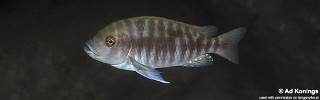
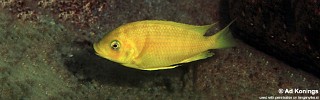
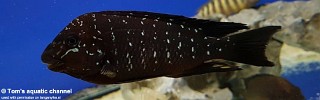
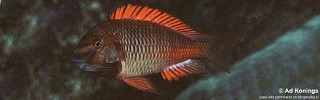
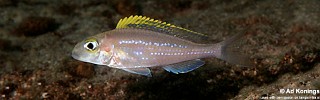



Petrochromis trewavasae is a rather shy species and is usually encountered in small groups. No geographical variants are known. Both sexes show a background coloration ranging from chocolate brown to nearly black, depending on mood, with numerous cream-white spots on the body. These spots tend to disappear in dominant males. Unlike Petrochromis ephippium, this species lacks a distinctly coloured dorsal “saddle” and remains smaller, typically not exceeding 20–22 cm, whereas P. ephippium may reach around 25 cm.
Although not among the most aggressive members of the genus, P. trewavasae is rather intolerant toward conspecifics and other Petrochromis, especially its sister species P. ephippium. The general appearance, requirements, and behaviour are otherwise similar to those of P. ephippium.
Photo gallery