Eastern (Tanzanian) coast of Lake Tanganyika, from Karema
southwards to Lupote Rocks.
Typical adult size:
Approximately 12–13 cm total length
Sexual dimorphism:
Males are usually larger than females, as in
Chalinochromis brichardi and small
Julidochromis species, though occasional sex-size reversal
has been observed.
Recommended aquarium size:
100 L for a single bonded pair
Aquarium setup:
Rock-dominated aquarium with numerous crevices and caves.
Highly intolerant of conspecifics; best kept as a single bonded pair.
Groups require large aquaria (300–400 L or more).
Diet:
Feeds on invertebrates collected from the aufwuchs.
In aquarium, accepts most foods including frozen and live items
such as mysis and krill.
Breeding:
Pair-forming substrate spawner. Parents defend a moderately sized brood.
Juveniles show Julidochromis-like crawling behavior on rocks and do not
form free-swimming “clouds”.
Aggression:
Strongly aggressive towards conspecifics; aggression increases during
breeding and may extend to other nearby species.
Special notes:
Striped eastern Tanzanian representative of the bifrenatus complex.
Characterized by persistent longitudinal striping in adult fish.
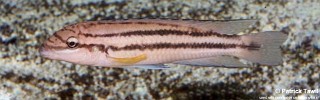
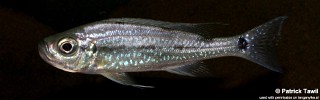





Photo gallery