Albertville (Kalemie), Lake Tanganyika, Democratic Republic of Congo
Biotope:
Sediment-rich rocky habitats and intermediate zones, often in shallow water but also occurring at
depths of approximately 5–15 m. Frequently found in turbid water and occasionally even in the Lukuga River,
the only outflow of Lake Tanganyika.
Geographic distribution:
Widely distributed in Lake Tanganyika. Occurs south of Baraka in the Democratic Republic of the
Congo, in Zambian waters, and south of the Malagarasi River in Tanzania.
Only two specimens from Kalemie are known to exceed 75 mm, while northern populations between Baraka and
the Malagarasi River include considerably larger individuals.
Typical adult size:
Highly variable geographically. Southern populations typically reach up to about 65–72 mm
total length, while northern populations may exceed 100 mm, with the largest recorded individual
measuring 113 mm.
Sexual dimorphism:
Pronounced. Males are substantially larger than females and may develop orange to red horizontal
markings on the head region; females remain much smaller, often 30–40 % smaller than males.
Recommended aquarium size:
120 L for a pair; substantially larger aquaria are required due to strong aggression.
Aquarium setup:
Extensive rockwork forming caves and crevices is essential. Spawning sites may include shallow
burrows beneath stones, pieces of wood, or empty snail shells.
Diet:
Predatory, feeding on a wide range of animal prey.
Stomach analyses indicate mainly invertebrates, with midge larvae being dominant.
Breeding:
Substrate brooder. Adult males typically maintain harems with several females.
Females defend and care for their own nests, while the male controls and defends the wider territory and
intervenes mainly in cases of serious threat.
Nest sites may be caves, shallow burrows, or empty snail shells. Clutch sizes are usually between 50 and
100 eggs per spawn.
Aggression:
Extremely aggressive, especially between males, and highly territorial towards other species,
particularly when defending nest sites.
Special notes:
Considerable geographic variation exists in size and coloration across the range of this species.
Northern populations are markedly larger than southern ones and have been treated by some authors as a
distinct taxon. Telmatochromis dhonti was historically confused with taxa such as T. caninus and
T. macrolepis, which were later synonymized or reinterpreted.
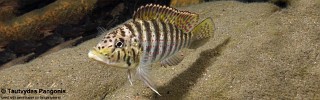
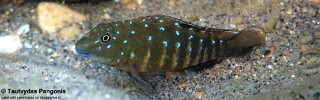
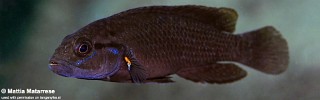
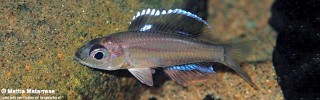
Adult individuals in the lake are uniformly dark brown; orange coloration commonly seen in aquarium strains
does not occur in wild adults.
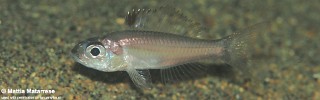



Only two specimens from Kalemie are known to exceed 75 mm, while northern populations between Baraka and the Malagarasi River include considerably larger individuals.
Stomach analyses indicate mainly invertebrates, with midge larvae being dominant.
Females defend and care for their own nests, while the male controls and defends the wider territory and intervenes mainly in cases of serious threat.
Nest sites may be caves, shallow burrows, or empty snail shells. Clutch sizes are usually between 50 and 100 eggs per spawn.
Telmatochromis dhonti was historically confused with taxa such as T. caninus and T. macrolepis, which were later synonymized or reinterpreted.
Adult individuals in the lake are uniformly dark brown; orange coloration commonly seen in aquarium strains does not occur in wild adults.
Photo gallery