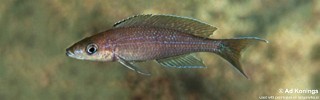
Kalungwe, Lake Tanganyika, Democratic Republic of Congo
Biotope:
Inhabits the intermediate habitat of Lake Tanganyika, where sandy areas meet rocks.
The species is most commonly encountered at depths of about 3–10 m.
Geographic distribution:
Endemic to Lake Tanganyika and recorded around almost the entire lake.
It is absent from the stretch between Kigoma and Nyanza-Lac, where it is replaced by
Ophthalmotilapia sp. ‘Paranasuta’. O. nasuta and O. sp. ‘Paranasuta’ have not been found together in the natural habitat.
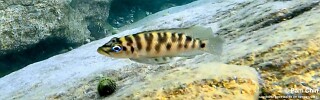
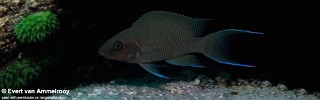
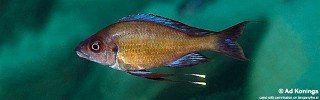
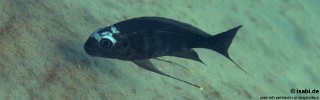
A lake-wide complex of geographically separated variants is reported, including a dark form from the far north
(e.g., Uvira), the so-called “Tiger Nasuta” between Kalemie and Chimba, yellow forms (e.g., Kipili), bronze forms
with blue fins (e.g., Mahili), and banded variants from Burundi.
Typical adult size:
Males reach approximately 20 cm, with females a few centimeters smaller.
Sexual dimorphism:
Only males develop strong coloration, while females remain comparatively plain.
Males also have noticeably longer fins than females, especially the pelvic fins.
Recommended aquarium size:
500 L, or at least 150 cm tank length.
Aquarium setup:
Ophthalmotilapia nasuta differs from other Ophthalmotilapia by inhabiting the
intermediate habitat rather than strictly rocky littoral zones.
It is described as less aggressive than other species of the genus, but due to its larger size it still requires
a large aquarium.
Provide fine sand, as males construct a volcano-shaped spawning mound; compared to other
Ophthalmotilapia, the nest is larger, reported at about 25–30 cm in diameter and around 10 cm in height.
In addition to a large open sandy area, include some rockwork and ideally at least one large flat rock, as males
often choose such surfaces as the basis for nesting and spawning.
It is best kept in groups with more females than males.
Diet:
Omnivorous, feeding on items available in the water column.
Reported diet consists mainly of plankton and small crustaceans, as well as various microorganisms.
Breeding:
Maternal mouthbrooder, breeding in a manner comparable to other Ophthalmotilapia.
Males gather in breeding colonies and build large sand bowers, typically on top of rocks, spaced a few meters
apart; colonies may include more than 20 males.
Spawning occurs within the bower. The female is attracted by the yellow lappets at the ends of the pelvic fins
rather than anal-fin ocelli, and after spawning she mouthbroods alone.
Clutch size is commonly around 20 eggs, and incubation is reported at approximately three weeks; after release,
fry may form large schools in the upper water layer together with other juvenile cichlids.
After spawning, removal of the female is sometimes recommended due to male aggression.
Aggression:
Described as less aggressive than other species of Ophthalmotilapia, though males still defend
nesting territories.
Special notes:
Ophthalmotilapia nasuta is a “featherfin” cichlid, named for the extremely elongated pelvic
fins, and is readily recognized by its very prominent nose, which gave the species its name.
The species was originally described as Ophthalmochromis nasutus by Poll & Matthes (1962) following
Poll’s earlier definition of Ophthalmochromis (1956), and later transferred to Ophthalmotilapia
after the synonymization of the genera (Liem, 1981). The description was based on specimens from Kalungwe near
Uvira in the far north of DR Congo, with additional material reported from across the lake.
Field and aquarium literature note substantial geographic variation across the lake-wide complex. A recurring
distinction is that many southern and south-eastern populations are markedly deeper-bodied than the more
elongated, shallow-bodied northern type associated with the type locality.
A group of yellow to golden, deep-bodied south-eastern populations has been referred to in the hobby as “Golden
Nasuta” or O. sp. ‘Nasuta Golden’; on tanganyika.si these forms are treated together within
O. nasuta as part of a broader lake-wide complex of closely related, allopatrically distributed forms. Ophthalmotilapia sp. ‘paranasuta’ has a less pronounced nose and replaces O. nasuta between
Kigoma and Nyanza-Lac; it has been emphasized that the two have not been found together in the wild, and that
females of O. nasuta may show dark vertical flank bars that are reported to be absent in females of
O. sp. ‘Paranasuta’.



The species is most commonly encountered at depths of about 3–10 m.
It is absent from the stretch between Kigoma and Nyanza-Lac, where it is replaced by Ophthalmotilapia sp. ‘Paranasuta’.
O. nasuta and O. sp. ‘Paranasuta’ have not been found together in the natural habitat.
A lake-wide complex of geographically separated variants is reported, including a dark form from the far north (e.g., Uvira), the so-called “Tiger Nasuta” between Kalemie and Chimba, yellow forms (e.g., Kipili), bronze forms with blue fins (e.g., Mahili), and banded variants from Burundi.
Males also have noticeably longer fins than females, especially the pelvic fins.
It is described as less aggressive than other species of the genus, but due to its larger size it still requires a large aquarium.
Provide fine sand, as males construct a volcano-shaped spawning mound; compared to other Ophthalmotilapia, the nest is larger, reported at about 25–30 cm in diameter and around 10 cm in height.
In addition to a large open sandy area, include some rockwork and ideally at least one large flat rock, as males often choose such surfaces as the basis for nesting and spawning.
It is best kept in groups with more females than males.
Reported diet consists mainly of plankton and small crustaceans, as well as various microorganisms.
Males gather in breeding colonies and build large sand bowers, typically on top of rocks, spaced a few meters apart; colonies may include more than 20 males.
Spawning occurs within the bower. The female is attracted by the yellow lappets at the ends of the pelvic fins rather than anal-fin ocelli, and after spawning she mouthbroods alone.
Clutch size is commonly around 20 eggs, and incubation is reported at approximately three weeks; after release, fry may form large schools in the upper water layer together with other juvenile cichlids.
After spawning, removal of the female is sometimes recommended due to male aggression.
The species was originally described as Ophthalmochromis nasutus by Poll & Matthes (1962) following Poll’s earlier definition of Ophthalmochromis (1956), and later transferred to Ophthalmotilapia after the synonymization of the genera (Liem, 1981). The description was based on specimens from Kalungwe near Uvira in the far north of DR Congo, with additional material reported from across the lake.
Field and aquarium literature note substantial geographic variation across the lake-wide complex. A recurring distinction is that many southern and south-eastern populations are markedly deeper-bodied than the more elongated, shallow-bodied northern type associated with the type locality.
A group of yellow to golden, deep-bodied south-eastern populations has been referred to in the hobby as “Golden Nasuta” or O. sp. ‘Nasuta Golden’; on tanganyika.si these forms are treated together within O. nasuta as part of a broader lake-wide complex of closely related, allopatrically distributed forms.
Ophthalmotilapia sp. ‘paranasuta’ has a less pronounced nose and replaces O. nasuta between Kigoma and Nyanza-Lac; it has been emphasized that the two have not been found together in the wild, and that females of O. nasuta may show dark vertical flank bars that are reported to be absent in females of O. sp. ‘Paranasuta’.
Photo gallery