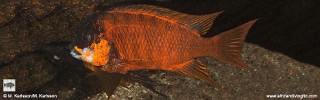
Luhanga, Lake Tanganyika, , Democratic Republic of Congo
Biotope:
Shallow, sediment-free rocky shores densely covered with algae.
Geographic distribution:
Has an almost lake-wide distribution. It has not been recorded along the Burundi shores nor in
Tanzania between Ikola and Taala Point. In Tanzania it occurs from the Ikola area northwards and from Taala
Point (near Wampembe) southwards.
Typical adult size:
Reaches around 20 cm total length and may grow even larger in aquaria.
Recommended aquarium size:
Although smaller individuals may be kept in 500 L aquaria, a minimum of 800 L is preferable.
Aquarium setup:
A spacious aquarium with extensive piles of rocks arranged to form caves and distinct territories,
combined with a sandy substrate. Strong water movement, high oxygenation and powerful filtration are required.
Bright lighting is beneficial to promote algal growth on rocks. Water should be hard and alkaline (pH
approximately 7.8–9.0) with temperatures maintained between 23–28 °C and low nitrate levels ensured through
regular water changes.
Diet:
Feeds on the algal layer covering rocks and actively defends feeding territories against
conspecifics. In aquaria, the main part of the diet should consist of vegetable-based foods, especially
spirulina-rich flakes. High-protein food must be given only sparingly.
Breeding:
Maternal mouthbrooder. The clutch usually comprises around 15 eggs or more. After spawning, the
female leaves the male’s territory. As in other members of the genus, and unlike Tropheus, the anal fin bears
true ocelli that attract the female toward the genital region.
Aggression:
Extremely aggressive toward conspecifics and may also be lethal toward other tropheines or any
haplochromine cichlids with vertical barring kept together with it.
Special notes:
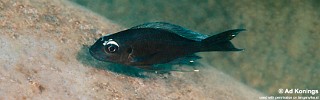
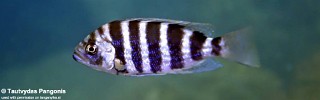
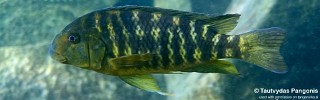
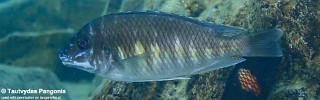
Distinguished from all other Petrochromis by its strongly projecting upper jaw and pronounced
premaxillary ascending process, resulting in the most strongly downturned mouth within the genus. Even when
the mouth is closed, a wide gap remains between the jaws.
Together with Petrochromis polyodon and related forms, it represents one of the most specialized members of
the genus, possessing wide dental pads that allow the removal of large amounts of algal biocover with each
scraping movement. The strongly downturned mouth enables grazing at a reduced angle to the substrate,
comparable in functional terms to scraping genera such as Tropheus and Pseudosimochromis, allowing improved
vigilance against threats from above.
Some undescribed species also show a downturned mouth (e.g. Petrochromis sp. 'kasumbe rainbow'), but with
a narrower gape at the tip. Petrochromis macrognathus grows very large and is regarded as one of the most
aggressive cichlids in Lake Tanganyika.



Bright lighting is beneficial to promote algal growth on rocks. Water should be hard and alkaline (pH approximately 7.8–9.0) with temperatures maintained between 23–28 °C and low nitrate levels ensured through regular water changes.
Together with Petrochromis polyodon and related forms, it represents one of the most specialized members of the genus, possessing wide dental pads that allow the removal of large amounts of algal biocover with each scraping movement. The strongly downturned mouth enables grazing at a reduced angle to the substrate, comparable in functional terms to scraping genera such as Tropheus and Pseudosimochromis, allowing improved vigilance against threats from above.
Some undescribed species also show a downturned mouth (e.g. Petrochromis sp. 'kasumbe rainbow'), but with a narrower gape at the tip. Petrochromis macrognathus grows very large and is regarded as one of the most aggressive cichlids in Lake Tanganyika.
Photo gallery