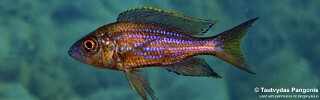
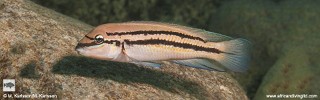
Moliro, Lake Tanganyika, Democratic Republic of Congo.
Biotope:
Primarily inhabits deeper sandy habitats of the lake.
Adult individuals migrate into shallow intermediate habitats only for spawning.
Geographic distribution:
Lake Tanganyika; distributed lake-wide.
Typical adult size:
Males commonly reach 70 cm total length and may exceed 3 kg in weight.
Females are smaller, typically around 50 cm total length.
Sexual dimorphism:
Females are approximately 25–30% smaller than males.
External coloration differences between sexes are minimal.
Recommended aquarium size:
At least 1500 L for long-term maintenance.
Aquarium setup:
Very large aquarium with extensive open swimming space.
Fine sand substrate; rocks may be present but should be smooth and placed
to allow unobstructed movement.
Can be kept in small groups, but space is critical.
Diet:
Carnivorous.
Adults are strictly piscivorous and will consume any fish small enough to swallow.
Juveniles (up to ~20 cm) also feed on larger invertebrates.
Breeding:
Substrate spawner with biparental care.
Spawning occurs in shallow intermediate habitats near rocks.
Eggs are deposited on flat stones, shells, or in shallow sand craters.
Extremely large clutches of approximately 5,000–12,000 eggs are produced.
Both parents guard eggs and fry intensively; during brood care the parents do not feed
and may die from starvation. Fry may be guarded until reaching very large sizes.
Aggression:
Very aggressive, especially between males and during brood care.
Highly territorial when guarding eggs or fry.
Special notes:
The largest cichlid species in Lake Tanganyika and the largest cichlid species known worldwide.
One of the fastest-growing cichlids: individuals may reach ~20 cm within the first year
and 40–50 cm in the second year, at which point they are already capable of breeding.
In the lake, this species is also valued as a food fish due to its large size and firm flesh.



Fine sand substrate; rocks may be present but should be smooth and placed to allow unobstructed movement.
Can be kept in small groups, but space is critical.
Adults are strictly piscivorous and will consume any fish small enough to swallow.
Juveniles (up to ~20 cm) also feed on larger invertebrates.
Spawning occurs in shallow intermediate habitats near rocks.
Eggs are deposited on flat stones, shells, or in shallow sand craters.
Extremely large clutches of approximately 5,000–12,000 eggs are produced.
Both parents guard eggs and fry intensively; during brood care the parents do not feed and may die from starvation. Fry may be guarded until reaching very large sizes.
One of the fastest-growing cichlids: individuals may reach ~20 cm within the first year and 40–50 cm in the second year, at which point they are already capable of breeding.
In the lake, this species is also valued as a food fish due to its large size and firm flesh.
Photo gallery