Deep rocky habitat, usually at depths of 20 m or more. Juveniles may occur at
somewhat shallower depths depending on locality. Lives in social groups.
Geographic distribution:
Lake Tanganyika. Northern populations (DR Congo north of Kavala Islands and
Tanzania north of Sibwesa) are generally referred to as
Cyphotilapia frontosa. Southern populations are often treated as
Cyphotilapia gibberosa by some authors. Central lake populations
(Mahale Mountains NP, Kavala Islands, and parts of central DR Congo) show
intermediate characteristics and are often referred to as C. cf. frontosa.
Typical adult size:
Males commonly reach 35 cm TL or more. In aquaria they may grow even larger.
Sexual dimorphism:
Males are larger than females and develop a more pronounced nuchal hump.
Sexual differences become increasingly obvious with age.
Recommended aquarium size:
At least 1000 L; larger aquaria strongly recommended.
Aquarium setup:
Best kept in groups, preferably in a species-only aquarium or together with
other large Tanganyikan cichlids such as Lepidiolamprologus,
Gnathochromis, or larger Neolamprologus. Smaller cichlids
(e.g. Julidochromis, Cyprichromis) are unsuitable as they may
be preyed upon. The aquarium should replicate their natural habitat with
subdued lighting, extensive rockwork, and ample open swimming space.
Diet:
Predatory. Juveniles feed mainly on soft-bodied crustaceans, while adults are
primarily piscivorous. Stomach content analyses of wild specimens reveal
remains of fish, mussels, insect larvae, shrimps, and snails. In captivity,
this species is known to consume tankmates up to nearly half its own size.
Breeding:
Maternal mouthbrooder with a unique spawning behaviour. Males do not excavate
nests nor defend strict territories. Spawning takes place within the group at
loosely defended sites. The female lays eggs while moving backwards over the
spawning site and collects them without the typical turning behaviour seen
in other mouthbrooders. Eggs are brooded for approximately five weeks before
the fry are released.
Aggression:
Generally moderate within the group structure, but adults are highly predatory
and dominant due to their size.
Special notes:
The taxonomy of Cyphotilapia is debated. Some authors recognise only
a single species (C. frontosa), while others distinguish
C. frontosa and C. gibberosa, and occasionally a third form
referred to as C. sp. 'North' or '6-bar frontosa'.
Cyphotilapia frontosa was described by Boulenger (1906) from Kigoma and
is typically characterised by six body bars plus one head bar (often called
the “7-bar frontosa” in the hobby). C. gibberosa was described later
(Takahashi & Nakaya, 2003) from the southernmost part of the lake and generally
shows five body bars plus one head bar.
Central lake populations show overlapping morphometric and meristic characters
of both forms, leading some authors (e.g. Ad Konings) to treat
C. gibberosa as a junior synonym of C. frontosa. African Diving
suggests these intermediate populations may be of hybrid origin following
historical lake-level fluctuations.
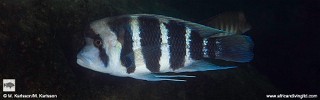
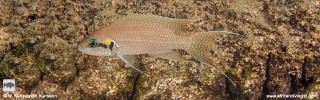
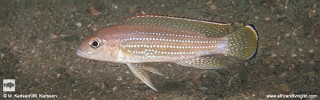



Cyphotilapia frontosa was described by Boulenger (1906) from Kigoma and is typically characterised by six body bars plus one head bar (often called the “7-bar frontosa” in the hobby). C. gibberosa was described later (Takahashi & Nakaya, 2003) from the southernmost part of the lake and generally shows five body bars plus one head bar.
Central lake populations show overlapping morphometric and meristic characters of both forms, leading some authors (e.g. Ad Konings) to treat C. gibberosa as a junior synonym of C. frontosa. African Diving suggests these intermediate populations may be of hybrid origin following historical lake-level fluctuations.
Photo gallery