Southern part of the Democratic Republic of Congo. This form is reported south of the Lunangwa
River and probably extends to the Moliro area. Populations attributed to this form have been found at
Lupota, Kisiki, Litimba, and Livua, all located between Moliro and the Lunangwa River.
Special notes:
Two leleupi-like forms occur in the southern part of the Democratic Republic of Congo that are
considered intermediate between N. leleupi and N. mustax. Between the Lunangwa River
and Nkorosha, Neolamprologus sp. ‘Leleupi Kapampa’ is found, while south of the Lunangwa River
and likely extending to Moliro, Neolamprologus sp. ‘Leleupi Blue Chin’ occurs.
Neolamprologus sp. ‘Leleupi Kapampa’ was discovered by Ad Konings at Kapampa and has also been
exported from Kiku and Lunangwa. Heinz H. Büscher reported whitish leleupi-like populations from
Nkorosha, which are considered very likely conspecific with the Kapampa form.
Neolamprologus sp. ‘Leleupi Blue Chin’ was named and exported by African Diving from Lupota.
Heinz H. Büscher additionally documented populations with orange body coloration and a blackish throat
at Kisiki, Litimba, and Livua. A form imported in the aquarium hobby as N. leleupi ‘Myunga’ is
regarded as distinct from true N. leleupi and corresponds in both distribution and appearance
with Neolamprologus sp. ‘Leleupi Blue Chin’.
Leleupi-like species in this region commonly occur in multiple color variants, including yellow,
beige, dark brown, and nearly black. In several locations, different color variants have been observed
living together.
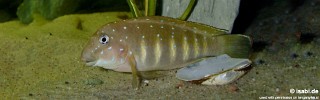
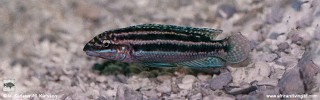
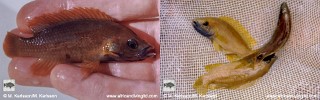
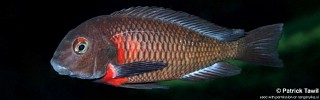



Neolamprologus sp. ‘Leleupi Kapampa’ was discovered by Ad Konings at Kapampa and has also been exported from Kiku and Lunangwa. Heinz H. Büscher reported whitish leleupi-like populations from Nkorosha, which are considered very likely conspecific with the Kapampa form.
Neolamprologus sp. ‘Leleupi Blue Chin’ was named and exported by African Diving from Lupota. Heinz H. Büscher additionally documented populations with orange body coloration and a blackish throat at Kisiki, Litimba, and Livua. A form imported in the aquarium hobby as N. leleupi ‘Myunga’ is regarded as distinct from true N. leleupi and corresponds in both distribution and appearance with Neolamprologus sp. ‘Leleupi Blue Chin’.
Leleupi-like species in this region commonly occur in multiple color variants, including yellow, beige, dark brown, and nearly black. In several locations, different color variants have been observed living together.
Photo gallery