Open water along deep rocky shores. Occurs at depths of approximately
5–30 m. Forms very large schools, often numbering hundreds or even
thousands of individuals, frequently together with
Cyprichromis microlepidotus, C. sp. 'leptosoma jumbo',
Paracyprichromis nigripinnis and P. brieni.
Geographic distribution:
Endemic to Lake Tanganyika. Occurs exclusively along the eastern shore,
from Kasakalawe in Zambia northwards to Magambo in Tanzania.
Typical adult size:
The smallest species in the genus Cyprichromis.
Males rarely exceed 9 cm total length; females are usually about
1 cm smaller.
Sexual dimorphism:
Males are slightly larger and more intensely coloured than females.
Males are polymorphic, with both blue-tailed and yellow-tailed morphs
occurring within the same population.
Recommended aquarium size:
Minimum 300 L (tank length at least 130 cm)
Aquarium setup:
A schooling species that should be kept in groups of at least 12
individuals. Provide ample open swimming space with only a limited
number of rocks for shelter. Substrate type is not critical, as this
species feeds and breeds in the water column. Avoid housing with large
piscivorous cichlids such as Cyphotilapia frontosa.
Suitable tank mates include species of
Paracyprichromis, Ectodus and Xenotilapia.
A tight-fitting lid is essential, as this species is prone to jumping.
Diet:
Carnivorous planktivore. In nature feeds primarily on zooplankton,
supplemented by small invertebrates and occasionally cyanobacteria.
Prey is captured using a highly protrusible mouth. In the aquarium,
most foods are accepted, though live and frozen foods promote the
best coloration.
Breeding:
Maternal mouthbrooder. Males establish three-dimensional territories
in open water and court passing females. Eggs (usually 6–14, approx.
3.5 mm in diameter) are laid singly and immediately taken into the
female’s mouth. Incubation lasts approximately 3–4 weeks.
Females often release fry synchronously. Fry form large pelagic
aggregations and may associate with broods of
Lepidiolamprologus profundicola, which tolerates and shelters
them.
Aggression:
Relatively peaceful. Males may display and engage in minor conflicts
while defending their three-dimensional territories in open water.
Special notes:
Cyprichromis leptosoma is the smallest and most slender species
in the genus and is often incorrectly used as a catch-all name for
other Cyprichromis species. It can be distinguished from
C. sp. 'leptosoma jumbo' by its smaller adult size, more
slender body and the characteristic brilliant blue sheen on the top
of the head.
Four geographical variants are recognised, differing mainly in fin
coloration and distribution:
Karilani – Occurs north of Kasoje, around Karilani Island
and Bulu Point. Similar to the Malasa variant, but yellow-tailed males
lack the yellow spot at the tip of the dorsal fin. Blue-tailed males
show a black spot at the end of the caudal fin and an orange-yellow
body coloration.
Ikola – Found along rocky shores between Ikola and Miyako.
Yellow-tailed males are characterised by a yellow anal fin, which can
be very bright in some individuals.
Malasa – Distributed from Samazi (north of Kasanga)
southwards to Cape Mpimbwe, representing the largest distribution range
of all C. leptosoma variants. Yellow-tailed males have a blue
dorsal fin and a yellow spot at the end of the caudal fin. In blue-tailed
males this spot is black, though it may be faint or absent.
Mpulungu – Occurs from Kasakalawe northwards along the
eastern shore to Kasanga. Blue-tailed males have a light blue dorsal
fin with fine black dots, while yellow-tailed males show a distinct
black stripe along the lower part of the dorsal fin.
The aquarium name “Mpulungu” refers to a colour variant rather than the
actual collection locality; specimens sold under this name usually
originate from Chituta or Mbita Island rather than from Mpulungu itself.
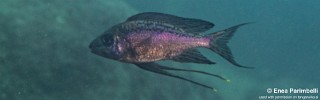

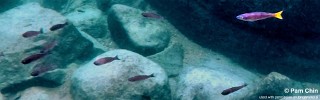
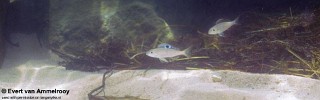
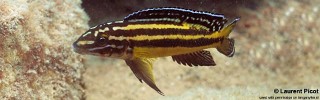



Four geographical variants are recognised, differing mainly in fin coloration and distribution:
Karilani – Occurs north of Kasoje, around Karilani Island and Bulu Point. Similar to the Malasa variant, but yellow-tailed males lack the yellow spot at the tip of the dorsal fin. Blue-tailed males show a black spot at the end of the caudal fin and an orange-yellow body coloration.
Ikola – Found along rocky shores between Ikola and Miyako. Yellow-tailed males are characterised by a yellow anal fin, which can be very bright in some individuals.
Malasa – Distributed from Samazi (north of Kasanga) southwards to Cape Mpimbwe, representing the largest distribution range of all C. leptosoma variants. Yellow-tailed males have a blue dorsal fin and a yellow spot at the end of the caudal fin. In blue-tailed males this spot is black, though it may be faint or absent.
Mpulungu – Occurs from Kasakalawe northwards along the eastern shore to Kasanga. Blue-tailed males have a light blue dorsal fin with fine black dots, while yellow-tailed males show a distinct black stripe along the lower part of the dorsal fin.
The aquarium name “Mpulungu” refers to a colour variant rather than the actual collection locality; specimens sold under this name usually originate from Chituta or Mbita Island rather than from Mpulungu itself.
Photo gallery