Neolamprologus sp. 'gracilis tanzania' lives in dense groups in deeper rocky and intermediate habitats, most commonly at depths between 5 and 30 m, and is only rarely encountered in very shallow water. The majority of the population occupies predominantly rocky zones between 7 and 15 m depth.
Geographic distribution:
Central eastern shore of Lake Tanganyika along the Mahale coast. Occurs north of
Sibwesa and probably extends northwards to the Lubulungu River area. Found
sympatrically with N. sp. 'princess lyamembe' and N. savoryi.
Typical adult size:
Approximately 7–8 cm total length excluding the caudal-fin extensions; including
the filamentous tail extensions, individuals may exceed 10 cm.
Sexual dimorphism:
No obvious sexual dimorphism. Males are on average slightly larger and less rounded
in the abdominal region.
Recommended aquarium size:
At least 150 liters for a species-only colony. In community aquaria, a minimum of
300 liters is recommended due to colony expansion and territorial behaviour.
Aquarium setup:
A rock-dominated setup with extensive piles of stones forming numerous caves and
passages. Rocks should preferably extend high toward the back of the aquarium.
Fine sand may be present but is of secondary importance.
Diet:
Carnivorous. Feeds mainly on small invertebrates such as insect larvae and
copepods, taken from the biocover and the water column.
Breeding:
A cooperative breeder forming large colonies. Each breeding pair occupies a small
rocky cave and guards its offspring with the help of numerous “helpers”, typically
juveniles from previous broods. Clutches usually consist of 20–50 eggs. Fry feed
on plankton once free-swimming.
Aggression:
Moderately aggressive within the species, but generally less aggressive than
N. brichardi and N. pulcher. Territorial aggression increases
during breeding.
Special notes:
Neolamprologus sp. 'gracilis tanzania' belongs to the N. savoryi
species complex and is extremely similar to N. gracilis from the Congolese
shore. Morphologically, it cannot be reliably distinguished from N. gracilis,
although it differs clearly from other Princess species such as N. marunguensis,
N. crassus, and N. falcicula by a combination of body shape, fin
morphology, and coloration.
Molecular data (Ronco et al., 2020) indicate that N. sp. 'gracilis
tanzania' is the sister taxon to N. gracilis, and the two may represent
eastern and western populations of the same species. Both share a preference for
deeper rocky habitats and display exceptionally long filamentous extensions of
the caudal fin, among the longest of all Princess cichlids.
The species is highly social and forms dense, long-lasting colonies that may
occupy the same section of habitat for decades. Group living appears to be driven
primarily by predator avoidance rather than by limited breeding sites.
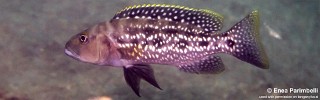
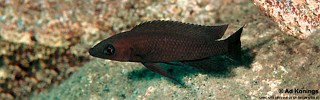
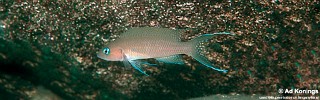
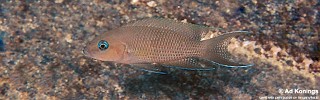
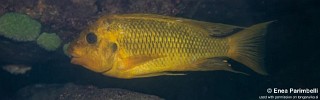



Molecular data (Ronco et al., 2020) indicate that N. sp. 'gracilis tanzania' is the sister taxon to N. gracilis, and the two may represent eastern and western populations of the same species. Both share a preference for deeper rocky habitats and display exceptionally long filamentous extensions of the caudal fin, among the longest of all Princess cichlids.
The species is highly social and forms dense, long-lasting colonies that may occupy the same section of habitat for decades. Group living appears to be driven primarily by predator avoidance rather than by limited breeding sites.
Photo gallery