Telmatochromis salzburgeri 'Lufubu River' Telmatochromis sp. 'lufubu' Lufubu River
Tribe / Genus:
Lamprologini / Telmatochromis
Type locality:
Northern Province, Lufubu drainage, Nsumbu National Park, lower Lufubu at Chomba village, ~30 km above confluence with Lake Tanganyika.
Biotope:
Occurs throughout the river, occupying quiet, sandy areas in deeper
passages as well as shallow rapids, where it primarily stays close to
large rocks for cover.
Geographic distribution:
Restricted to the Lufubu River (Lake Tanganyika drainage) on the Zambian
coast. Specimens are reported from the lower river, collected near
Chomba village, about 32 km upstream from the river mouth.
Typical adult size:
The largest type specimen is 4.8 cm standard length (about 6 cm total
length). A maximum length of 8 cm total length is also reported.
Sexual dimorphism:
Females are much smaller than males. They are less colorful and show
rounder paired fins and a rounder belly.
Recommended aquarium size:
Around 100 L can be sufficient for keeping and breeding a pair, and may
be smaller if the pair is well matched.
Aquarium setup:
Provide caves and tight shelters such as crevices or shells for spawning,
with sandy areas for foraging. Water reported from the Lufubu River is
alkaline and moderately hard (pH 8.68; 17 °dH), with seasonal
variability. Temperatures may approach 30 °C in the river, while in the
aquarium it is stated as preferable to keep temperatures lower, with a
maximum of 25 °C.
Diet:
Feeds mainly on small benthic organisms picked from sand. Males are
described as strongly territorial; juveniles may occur in small groups
while feeding.
Breeding:
Biparental substrate spawner and a cave spawner, with eggs hidden inside
shells or crevices. Parents defend the breeding territory aggressively.
Fry are described as easy to raise on Artemia nauplii and grow quickly.
Aggression:
A territorial and assertive Telmatochromis, with vigorous defense of
territory and intense chasing of intruders, including non-conspecifics.
Special notes:
Adult individuals are identified by a prominent orange stripe along the
dorsal-fin base, extending into the dorsal fin and over the dorsum.
Diagnostic comparisons provided also emphasize a relatively large head
and long jaws, and fewer dorsal-fin spines than members of the lake
complexes referenced in the text. It is described as a riverine offshoot
of Telmatochromis dhonti, adapted to flowing-water conditions.
The species is noted as a potential hybridizer if kept with other members
of Telmatochromis, including “lined” forms such as
Telmatochromis vittatus.
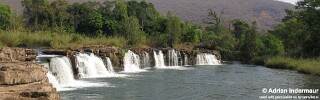
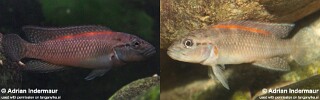

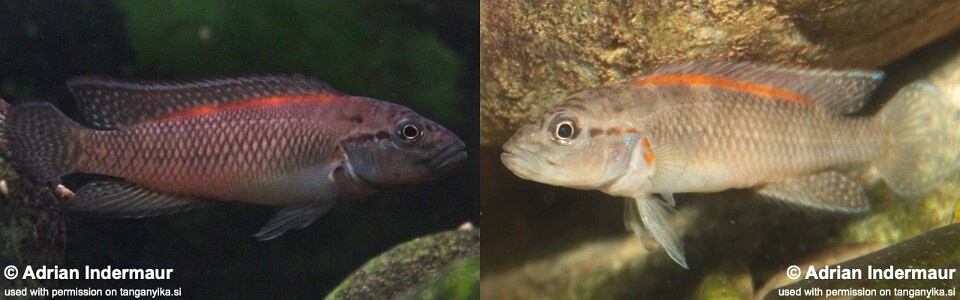



Photo gallery