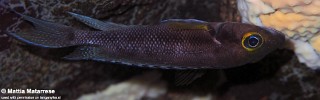
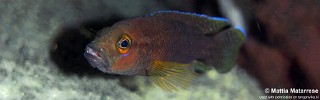
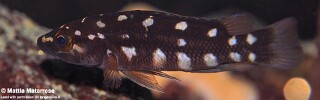
Luhanga, Lake Tanganyika, Democratic Republic of Congo
Biotope:
Sediment-rich intermediate sand–rock habitats.
The species inhabits depths from approximately 6 to 30 m
and spends most of its time hidden within rock crevices,
rarely venturing far from shelter.
Geographic distribution:
Northern part of Lake Tanganyika, from Sibwesa (Tanzania) to Kavala Islands
(Democratic Republic of Congo). The species is reputedly absent from Burundi.
Typical adult size:
Males reach around 9 cm total length,
while females remain significantly smaller,
usually up to about 5 cm.
Sexual dimorphism:
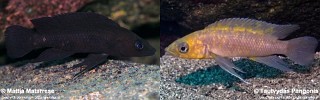
Sexes are alike, except that males are
markedly larger than females.
Recommended aquarium size:
150 liters (for a pair).
Aquarium setup:
A fine sand substrate is recommended.
Numerous rocks should be arranged to form many caves
and narrow hiding places.
Due to strong intraspecific aggression, only a single
pair should be kept in the aquarium.
In larger aquaria the species can be kept in a community
setup, but for breeding purposes a species-only aquarium
is preferable, as the small clutch size makes egg and fry
survival more difficult in the presence of other fishes.
Diet:
Carnivorous. Feeds on small invertebrates,
crustaceans, insect larvae and small snails.
Breeding:
A cave spawner.
Spawning takes place inside narrow rock crevices.
The clutch size is extremely small, usually only
3 to 4 eggs.
Both parents participate in brood care: the female
guards the eggs inside the cave, while the male
defends the area in front of the shelter.
Aggression:
Highly aggressive within the species.
Special notes:
Together with Neolamprologus obscurus,
this species is considered one of the most secretive and
shy cichlids of Lake Tanganyika.
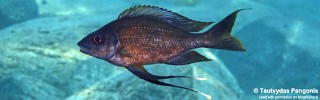



Due to strong intraspecific aggression, only a single pair should be kept in the aquarium.
In larger aquaria the species can be kept in a community setup, but for breeding purposes a species-only aquarium is preferable, as the small clutch size makes egg and fry survival more difficult in the presence of other fishes.
The clutch size is extremely small, usually only 3 to 4 eggs. Both parents participate in brood care: the female guards the eggs inside the cave, while the male defends the area in front of the shelter.
Photo gallery