Cyathopharynx sp. 'green flush' Kungwe Point Cyathopharynx foae 'Kungwe Point'
Tribe / Genus:
Ectodini / Cyathopharynx
Biotope:
Intermediate habitat close to rocky areas; typically encountered at depths between
5 and 25 m.
Geographic distribution:
Tanzania from north of Kalya to the Malagarasi River.
Also present in northern DR Congo from Uvira south to at least the
Kavala Islands, possibly extending to Kalemie.
This form shares habitat with Cyathopharynx furcifer at
Lyamembe and in the Sibwesa area, and appears to be
the only Cyathopharynx form north of the Malagarasi River and north of Kalemie in Congo.
Typical adult size:
Males up to ~22 cm TL; females notably smaller, usually 12–15 cm TL.
Sexual dimorphism:
Males are larger than females and develop longer, more elaborate fins,
particularly elongated pelvic fins extending well beyond the anal fin.
A demanding species requiring excellent and stable water quality.
A large area of fine sand is essential for the construction of large,
volcano-shaped breeding bowers. Rocks are optional but can help define territories.
This species should be the dominant fish in the aquarium and must not be kept with
aggressive or fin-nipping cichlids (e.g. Tropheus). Suitable tankmates include
peaceful sand-dwelling Tanganyikan cichlids from the tribes Ectodini,
Eretmodini, and Cyprichromini.
Lighting should not be strictly vertical; diffuse or slightly lateral light
enhances the display coloration of males.
Diet:
Herbivorous. In nature feeds mainly on diatoms and unicellular algae from the
aufwuchs. In the aquarium a plant-rich diet is essential due to the long and
sensitive digestive tract.
Breeding:
Maternal mouthbrooder. Males build large sand bowers, sometimes on top of flat rocks.
Females may spawn with several males by visiting multiple bowers.
Typical brood size ranges from 40 to 50 fry.
Aggression:
Males can be highly territorial and aggressive when defending their bower,
especially during the breeding period.
Special notes:
Cyathopharynx sp. 'Green Flush' is one of several dark
Cyathopharynx forms often treated by some authors as
Cyathopharynx foae. The name C. foae originates from
Ectodus foae (Vaillant, 1899), described without a type locality and now
regarded as a species inquirenda. Because of this taxonomic uncertainty,
African Diving treats the dark forms as separate, geographically defined entities.
Populations from northern Congo show yellow edges on the anal fin, resembling
Cyathopharynx sp. 'Furcifer North', and may represent an intermediate form,
though this can only be resolved through genetic studies.
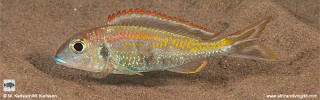
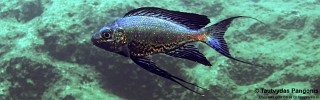



Photo gallery