Open water along deep rocky shores. Occurs at depths of approximately
5–30 m, where it lives in large schools.
Geographic distribution:
Western shore of Lake Tanganyika, from Kitumba to Mtoto.
Typical adult size:
One of the larger species in the genus Cyprichromis,
reaching approximately 12–14 cm total length.
Sexual dimorphism:
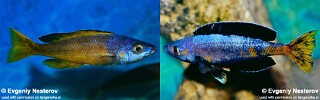
Males are larger, more colourful and highly polymorphic. Females are
more subdued in colour.
Recommended aquarium size:
Minimum 400 L (larger strongly recommended)
Aquarium setup:
Due to its size and slightly increased aggression, this species
requires a relatively large aquarium. A minimum of 400 L is
recommended, stocked with at least 3–4 males and at least an equal
number of females. Keeping only one male prevents the observation
of natural three-dimensional territorial displays, while keeping
only two males often results in excessive aggression directed at
the subordinate individual.
With several males, aggression is distributed and interactions are
more balanced, allowing all males to display full coloration. This
is particularly impressive given the extreme polymorphism of the
species, where no two males are coloured alike.
Provide some rocks for shelter, but ensure ample open swimming
space. Substrate choice is not critical, as the species does not
feed or spawn on the bottom.
Diet:
Carnivorous planktivore. In the wild feeds mainly on zooplankton,
supplementing with small invertebrates when plankton is scarce.
Uses a highly protrusible mouth to capture prey in open water.
In captivity accepts most foods, but live food improves colouration.
Breeding:
Maternal mouthbrooder. Males maintain three-dimensional territories
in open water and attempt to attract passing females. During
spawning, females are drawn to the yellow-tipped ventral fins and
rapidly collect the fertilised eggs in their mouth. Incubation
lasts approximately three weeks. Typical clutch size is 8–15 eggs,
but may exceed 20.
Aggression:
Moderately aggressive, especially during territorial defence.
Aggression level is similar to Cyprichromis leptosoma, but
due to its larger size the consequences can be more severe.
Not recommended to keep with weaker sand-dwelling Tanganyikan
cichlids.
Special notes:
This species was long considered a geographical variant of
Cyprichromis sp. 'leptosoma jumbo', but differs clearly in
coloration, body shape and distribution. The “true” jumbo originates
mainly from the eastern shore, while western populations represent
the “brilliant” type.
The most widespread form is the well-known “Kitumba jumbo”. A very
similar form from Moba is often sold under the trade name
“Speckleback”. African Diving Ltd. considers the population from
Cape Tembwe to represent a distinct endemic species
(Cyprichromis sp. 'Speckleback rainbow'), whereas
Ad Konings regards it as a geographical variant of
C. sp. 'brilliant jumbo'.
One of the most polymorphic species in the genus Cyprichromis.
Males range from entirely blue to entirely yellow, including all
intermediate colour combinations. Body shape is relatively slender,
similar to C. leptosoma, whereas the “true” jumbo from the
eastern shore is stockier and shows a more matte coloration,
especially on the head.
Fully adult males may change colour with age and dominance status.
Despite extreme polymorphism, females do not appear to show
preference for specific male colour morphs.

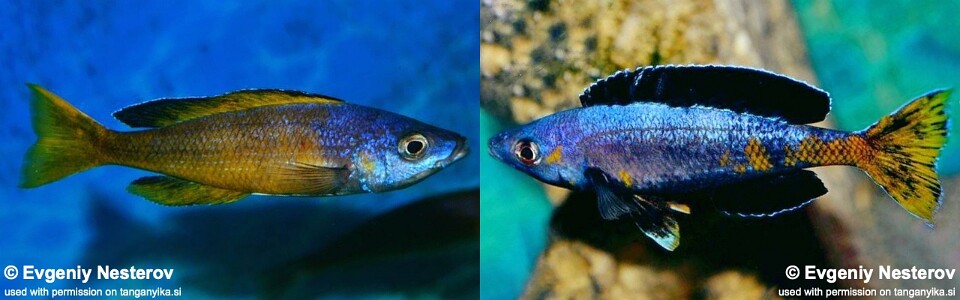



With several males, aggression is distributed and interactions are more balanced, allowing all males to display full coloration. This is particularly impressive given the extreme polymorphism of the species, where no two males are coloured alike.
Provide some rocks for shelter, but ensure ample open swimming space. Substrate choice is not critical, as the species does not feed or spawn on the bottom.
The most widespread form is the well-known “Kitumba jumbo”. A very similar form from Moba is often sold under the trade name “Speckleback”. African Diving Ltd. considers the population from Cape Tembwe to represent a distinct endemic species (Cyprichromis sp. 'Speckleback rainbow'), whereas Ad Konings regards it as a geographical variant of C. sp. 'brilliant jumbo'.
One of the most polymorphic species in the genus Cyprichromis. Males range from entirely blue to entirely yellow, including all intermediate colour combinations. Body shape is relatively slender, similar to C. leptosoma, whereas the “true” jumbo from the eastern shore is stockier and shows a more matte coloration, especially on the head.
Fully adult males may change colour with age and dominance status. Despite extreme polymorphism, females do not appear to show preference for specific male colour morphs.
Photo gallery